• Home
  • Faculty/Ark of Peace
    • New to A Course in Miracles??
    • SFACIM Dedication, Mission, and Vision (under nonprofit “Ark of Peace”
    • Our Teachers
    • The Teacher-Pupil Relationship
    • The Community of Love
    • Ark of Peace Nonprofit Org. (Includes SFACIM)
  • ACIM
    • How It Came
    • What It Is
    • What It Says
    • Foundation for A Course In Miracles (FACIM)
  • Classes/Events
    • SFACIM Daily Calendar of Classes & Discussion Sessions on Zoom
    • Recommended for Newcomers
    • Ongoing Classes
    • Past Classes and Events
  • Resources
  • Musings
    • Lyn Corona
    • Conversations with Ken Wapnick
  • Mentoring

School for A Course In Miracles

"The universe of learning will open up before you."

School for A Course In Miracles

“The universe of learning will open up before you in all its gracious simplicity.” T-14. II. 6:4
  • Beginners: New to “A Course in Miracles?”
  • Online ACIM Immersion Program
  • Audio
  • Video
  • Contact SFACIM
  • Topic Index/Site Map
You are here: Home / Archives for A Course in Miracles

Ten Common Mistakes ACIM Students Make… (Part One)

June 17, 2021


 Below is a list of what the School for ACIM considers to be some of the common mistakes that we all make as Course students.

(… by Tim Wise)

It would however be helpful to point out from the start that there is only one real mistake that we all consistently make when we are in ego mode, and that one mistake gets mirrored in all the different renditions in the world that reflect that first and only mistake that we made in our minds… and that is…

We took, and continue to take, the tiny mad idea (T.M.I.) of separation from Our Father in Heaven seriously, whenever we are experiencing anything less than true peace of mind. (Ch. 27, p.586, par.6)

If we hadn’t taken the idea of separation seriously when we pretended to step outside of Heaven, none of the other Course mistakes we seem to make would have, or could have followed, as distractions from recognizing that original silly error. We could have simply dropped the idea (the TMI) immediately as preposterous and impossible, and realize our experience of Heaven’s Oneness as our one and only true identity.

However we did, and do continue to take it seriously internally in our minds. Then rather than admit that and let the TMI go, we project it onto the world as bodies with all kinds of body problems and issues that distract us from the actual source.

2 A sense of separation from God is the only lack (i.e. mistake) you really need correct. This sense of separation would never have arisen if you had not distorted your perception of truth (our identity in Heaven), and had thus perceived yourself as lacking. The idea of order of needs (the mistaken belief that we could even have needs) arose because, having made this fundamental error (belief in separation), you had already fragmented yourself into levels with different needs.

 The idea of orders of need, which follows from the original error that one can be separated from God, requires correction at its own level (in the mind) before the error of perceiving levels at all can be corrected (and then we return to Heaven). 

(Text p.14)


——————————————————
 

The other awareness that would be helpful to look at and admit, if only at first intellectually, is the following…

Similar to the very first miracle principle in Chapter One that says there’s no order of difficulty in performing miracles… likewise there is no hierarchy of Course mistakes (indeed, no hierarchy of sins either), and no order of difficulty in correcting them. This is in spite of how much we think some mistakes and sins are more severe and serious than others.

They all equally have the same content (taking the TMI seriously), and need the same solution (letting judgement go). See WB Lessons 79-80: “One Problem, One Solution.”:

5. No one could solve all the problems the world appears to hold. They seem to be on so many levels, in such varying forms and with such varied content, that they confront you with an impossi­ble situation. Dismay and depression are inevitable as you regard them…

6. All this complexity is but a desperate attempt not to recognize the (real) problem, and therefore not to let it be resolved. If you could recognize that your only problem is (belief in) separation, no matter what form it takes, you could accept the answer because you would see its relevance. Perceiving the underlying constancy in all the problems that seem to confront you, you would understand that you have the means to solve them all. And you would use the means, because you recognize the (one and only) problem. (WB p.141)


We need the Holy Spirit’s or Jesus’ help (the voice for God inside us)… to forgive our mistakes and ‘sins’, i.e. to let go of our belief in their reality and their effects upon us. The very first miracle principle clearly affirms…

1 There is no order of difficulty in miracles . One is not harder or bigger than another. They are all the same.

(Text p. 3)

Jesus could have equally said, and certainly makes the point later… There is no order of difficulty in correcting mistakes also. One is not harder or bigger than another. They are all the same.



Mistakes We Make as Course Students:

 1) Level Confusion:    behavior/body/brain level… vs… mind level?

2) “I” can see my brothers’ sins as a call for love.

3) Asking Holy Spirit’s help to find a parking place…

4) Forgiveness-to-destroy

5) The “I” in… “I need do nothing.”

6) Using Workbook titles as affirmations…

7) The Course vs Genesis: The world was created by whom exactly?

8) My salvation (and my holiness) depends on my being a Good Course Student…. wrong.

9) Mis-identifying the Jesus of the Course with other Jesus(s), both channeled & biblical

10) Mixing the Course with other spiritual paths…


1) Level Confusion: behavior/body level or mind level?

This first mistake of level confusion really underlies all the other mistakes that we will look at. What does level confusion mean then? How many levels are there anyway?

The Course talks about three levels of experience… Heaven, the mind, and the body. Since we are identified at the the lower level of  believing we are bodies in the world, we really need to explore the difference between our seeming experience as bodies and how we get back to an awareness that we are really decision makers in our mind (constantly choosing between the ego as our guide, or the Holy Spirit).

The Course says that we need to realize that everything we do and think as bodies (and brains) in the world is only a reflection of one of two thoughts (ie, the choice of separation or forgiveness), or one of two teachers (the ego or HS) in our mind. When we do understand that choice fully and let the ego go, then God takes the “Last Step” and returns us to our awareness of our True Self in Heaven.

[N.B. In the Course our bodies and our personalities, including the body’s  brain and its brain thoughts, are all simply a reflection of one of two thoughts (ego or HS) in our mind. The mind is an internal level of experience inside us (that, in the Course, is not the same as our brain). It is an inner “place” where we choose the ego teacher of separation and guilt or the Holy Spirit as teacher of healing and forgiveness.]

As bodies, we believe the source of our lack of peace, and misery, comes from something causing us stress in the world… usually somebody’s behavior, usually yours, sometimes my own. Then we set about trying to fix that behavior or worldly condition as if it were the problem, even as Course students… We get confused about where the real source of our pain is, and where the miracle needs to take place to heal that pain (i.e. we need to learn that source is in our mind, and not the world).

Jesus clearly says early on in Chapter Two:

2 I do not foster level confusion, but you must choose to correct it. You would not excuse insane behavior on your part by saying you could not help it. Why should you condone insane thinking (choosing the ego in your mind)? There is a confusion here that you would do well to look at clearly. You may believe that you are responsible for what you do, but not for what you think. The truth is that you are responsible for what you think, because it is only at this level (in the mind) that you can exercise choice (which inner teacher we choose, ego or Holy Spirit). What you do comes from what you think (in your mind). You cannot separate yourself from the truth by “giving” autonomy to behavior…

 You must change your mind, not your behavior, and this is a matter of willingness. You do not need guidance except at the mind level. Correction belongs only at the level (in the mind) where change is possible. Change does not mean anything at the symptom level (in bodies and the world), where it cannot work. (Text p.29)

 Body appetites are not physical in origin. The ego regards the body as its home, and tries to satisfy itself through the body. But the idea that this is possible is a decision of the mind (choosing the ego), which has become completely confused about what is really possible. (I think I can fix things in the world and then find satisfaction and peace as a body.)

(Text p.58, par.7)



So when we begin to think and believe that any of our issues/problems at the level of the world and bodies are the actual source of our distress and concern, and that if only that person or situation would straighten out I would feel better, we are back in level confusion believing we are “upset for the reason we think.” (see WB Les. 5)

We then need to be willing to step back and ask Jesus for help to see that person or event a different way, from Jesus’ point of view in the mind. What if… I’m simply upset because I pushed Jesus and God away, and now I’m blaming my pain and lack of peace on something or someone else in the world?

1 Projection makes perception. The world you see is what you gave it, nothing more than that. But though it is no more than that, it is not less. Therefore, to you it is important. It is the witness to your state of mind, the outside picture of an inward condition. As a man thinketh, so does he perceive. Therefore, seek not to change the world, but choose to change your mind about the world. Perception is a result and not a cause. And that is why order of difficulty in miracles is meaningless. Everything looked upon with vision is healed and holy. Nothing perceived without it means anything. And where there is no meaning, there is chaos.

(Ch. 21, p.445, Par.1)


What is…

2) I, by myself, can see another’s sins as a call for love.

Most of us think as good Course students that we can choose to see something outrageous that our brother is doing… as a “call for love.” The answer is nope, not ‘us,’ not our job… But we can and must ask the Holy Spirit for help to do that if we don’t want to feel the pain and blame of judging. We don’t have to try figuring all that out by ourselves, and try to justify what others do or don’t do. Don’t try saying and believing maybe they had a “bad day,” or maybe even a bad life… Not only will it not work, it can’t work… It is simply not our function, but the Holy Spirit’s function to help us see beyond their mistakes to something else…

You may wonder how you who are still bound to judgment can be asked to do that (seeing a call for love), which requires no judgment of your own. The answer is very simple. The power of God (the Holy Spirit), and not of you, engenders miracles (the experience of seeing a call for love through the Holy Spirit’s vision)…

7 The only judgment involved is the Holy Spirit’s one division into two categories; one of love, and the other the call for love. You cannot safely make this division, for you are much too confused either to recognize love, or to believe that everything else is nothing but a call for love. You are too bound to form, and not to content. What you consider content is not content at all. It is merely form, and nothing else. (Text p.294)


 No one should attempt to answer these questions alone. Surely no teacher of God has come this far without realizing that… Ask and He (the Holy Spirit) will answer. The responsibility is His, and He alone is fit to assume it. To do so is His function. To refer the questions to Him is yours. Would you want to be responsible for decisions about which you understand so little. Be glad you have a Teacher Who cannot make a mistake. His answers are always right. Would you say that of yours?

The imagined usurping of functions not your own is the basis of fear. The whole world you see reflects the illusion that you have done so, making fear inevitable. To return the function to the One to Whom it belongs is thus the escape from fear. And it is this that lets the memory of love return to you. Do not, then, think that following the Holy Spirit’s guidance is necessary merely because of your own inadequacies. It is the way out of hell for you…He understands that an attack is a call for help. And He responds with help accordingly. (Manual p.70-71)

 Also, our brother’s call for help is really our own call for help! Hearing and answering a brother’s call for love is really hearing and answering our own. Don’t pretend it’s just about him, or actually about him at all…. If we are not seeing the truth of who our brothers and ourselves are, we are the ones with the problem….we are the ones calling for love.

Our own call for love should then be… Please help me see what You see, Holy Spirit!

Although your interpretations of reality are meaningless in your divided state, His (the HS interpretations of a call for love) remain consistently true. He gives them to you because they are for you. To fail to recognize a call for help is to refuse help (yourself). Would you maintain that you do not need it? Yet this is what you are maintaining when you refuse to recognize a brother’s appeal, for only by answering his appeal can you be helped. Deny him your help and you will not recognize God’s Answer to you. The Holy Spirit does not need your help in interpreting motivation, but you do need His.

Do not attempt to “help” a brother in your way, for you cannot help yourself. But hear his call for the Help of God, and you will recognize your own need (your own call) for the Father.

7 Your interpretations of your brother’s needs are your interpretation of yours. By giving help you are asking for it, and if you perceive but one need in yourself you will be healed. For you will recognize God’s Answer as you want It to be, and if you want It in truth, It will be truly yours. Every appeal you answer in the Name of Christ brings the remembrance of your Father closer to ‘your’ awareness. For the sake of ‘your’ need, then, hear every call for help as what it is, so God can answer ‘you’. (Text p. 216)



3) Asking HS help to find a parking place…

or whatever it is we think we need as a physical/psychological entity. Jesus tell us that it is ok to ask for specifics in the world, but we don’t want to stop with just that kind of asking. Our prayers need to evolve as we move in our awareness from the body level to the mind level as mentioned above…

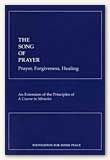
These references, and many other insightful looks at what prayer is, and what prayer isn’t, are in the Song of Prayer pamphlet and its in-depth discussion on “Prayer”: 


(p.3, par.2) These forms of prayer, or asking out of need, always involve feelings of weakness and inadequacy, and could never be made by a Son of God who knows Who he is… Yet it is also true that no one who is uncertain of his Identity could pray in these forms…

(p. 2, par.4) The secret of true prayer (eventually) is to forget the things you think you need. To ask for the specific is much the same as to look on sin and then forgive it. Also in the same way,  in prayer you overlook your specific needs as you see them, and let them go into God’s hands. There they become your gifts to Him, for they tell Him you would have no other God’s before Him; no Love but His.

Can this be traded for a bit of trifling advice about a problem of an instant’s duration?

Prayer should not be confused with supplication of any kind, because it is a way of remembering your holiness… There is nothing to ask because there is nothing left to want.  (Song of Prayer p. 2-3)

In our experience of prayer as maturing Course students, the prayer that Jesus asks us to pray the most in the Course is some version of this request… Holy Spirit, please help me see that person or situation the way You do, and please help me have the willingness to see all our true innocence as God’s One Son, beyond the others’ seeming sins and wrongdoings… and my own.

It is to be willing to hear Jesus and our brother say: “Give me your blessing, holy Son of God.” (Les.# 161)


4) Forgiveness-to-destroy

What the world thinks of as forgiveness isn’t really forgiveness. It’s  what the Course calls forgiveness-to-destroy. We don’t forgive a brother for what he or she did, but we learn to let go (forgive) our own believing that what they did was responsible for our pain. Jesus tell us …”do not set forgiveness in an earthly frame.”

The true source of any pain we are feeling and reacting to, is the pain of pushing God away and believing that we separated from Him in our minds. We don’t deny that we actually believe others are responsible for hurting us, but we ask for Jesus help to see that their innocence and ours is still intact (in spite of our internal guilt  for believing we could separate from source, and then projecting that guilt onto our brothers.)

For a complete understanding of true forgiveness compared to forgiveness-to-destroy (with specific examples of what each looks like), see Song of Prayer Supplement, #2. Forgiveness, sections I, II, and III (p.9-15).

Here is par. 4 on p. 10:

As prayer is always for yourself, so is forgiveness always given you. It is impossible to forgive another, for it is only your sins you see in him. You want to see them there and not in you. That is why forgiveness of another is an illusion… Only in someone else can you forgive yourself, for you have called him guilty of your sins, and in him must your innocence now be found….do not ever think you can see sin in anyone (ultimately) except yourself (in your mind).

There are four types or ways forgiveness-to-destroy is described in The Song of Prayer Pamphlet.  In all four our own belief in our own guilt is secretly maintained, and then projected on another, and seemingly ‘forgiven.’ (p. 12-13) 

(1) Holier than thou… I will forgive you because obviously I am the better person.

(2)  I am just as bad as you are… we both are sinful and deserving of punishment.

(3)  Behold me brother at your hand I die... I willingly suffer martyrdom to prove I’m innocent and you’re not.

(4)  Bargaining and compromise… I will forgive you if you meet my needs and are my slave.



5) The “I” in… “I need do nothing.”

When we hear that phrase quoted so often by Course students, we immediately tend to think of it in terms of behavior as a body with a psychological personality. What do you mean I need do nothing? What about working and eating and basically just surviving? If I did nothing I would die…

That line (“I need do nothing”) is the title of section VII in Chapter 18 “The Passing of The Dream.” (p.388)  It comes just after the section called “Beyond The Body.”

Jesus is trying to shift our body identification to an awareness of our selves as minds… and to have us stop insisting that we are weak helpless entities, victimized and plagued by all kinds of things. The “I,” that he is addressing in ‘I need do nothing,’ is that part of our mind that is constantly choosing between the ego (separation and sin) or the Holy Spirit (forgiveness: letting separation go). He’s reminding us that our true reality in heaven as God’s One Innocent Son is an already done deal, and all we have to “do” is stop pretending it isn’t.

I need do nothing to be holy. I don’t have to do all my workbook lessons perfectly, or take the right vitamins, or make the planet a better place to live, in order to have salvation. Jesus is not telling us not to do those things, but he’s letting us know he didn’t go anywhere because of what we did or didn’t do. He didn’t leave us (as the picture “Footprints in the Sand” points out). We simply keep trying to believe we left Jesus, and then blame him for abandoning us..

 

This is not a Course about “doing,” but this is a Course about perception. Am I looking at what I am doing thru the “eyes” of separation, or through Jesus’ vision?

This is not a Course about doing or affirming Love, but it is a Course about letting go of our blocks to our awareness of Love’s presence (Text Introduction, p.1)… that is, letting go of all our judgements about others and ourselves (how we see ourselves).

Then, realizing we’re really minds with Jesus by our side, we continue to do what we do everyday as bodies….eat, sleep, work, play… but without all the guilt of believing we pushed him (Jesus) away, and without all the taking ourselves so seriously.


For Part Two on the remaining five mistakes…

click here


Filed Under: Home Posts Tagged With: A Course in Miracles, ACIM, forgiveness, Ken Wapnick, Peace, SFACIM

GUILT, Part One: What is it, and Where is it ??

June 13, 2021

On Guilt, Part One:


“Do not be afraid to look within. The ego tells you all is black with guilt within you, and bids you not to look. Instead, it bids you look upon your brothers, and see the guilt in them. Yet this you cannot do without remaining blind. ” (Ch.13, Sec. IX)

 Guilt !

Why is the word guilt used and talked about in the Course almost 700 times?

Why does the Course insist we have to look at it, admit it, and let guilt go, if guilt isn’t real in the first place??

What is guilt anyway, and where and why is guilt hiding???

The good news: there’s only one internal kind of guilt in our minds that all external behavioral guilt is a reflection of… and it’s not real.

The bad news (from the ego’s point of view): there’s only one internal kind of guilt in our minds that all external behavioral guilt is a reflection of… and it’s not real.

What does that mean? All seeming guilt in the world, whether it’s your guilt for what you did, or it (maybe sometimes) is my guilt for what I did… has nothing to do with what and where the “real” guilt is lurking. The “real” guilt is always in the mind, and we feel it because we have chosen the internal teacher of separation (the ego) rather than the Voice for forgiveness (the Holy Spirit). Instead of admitting that, we then project that guilt (we call it blame, resentment, anger, whatever) onto other bodies, or our own. It is always simply a distraction from the actual source of guilt in our own mind for choosing to listen to the voice for separation, and then quickly forgetting we did that. So believing now we are bodies, we wind up thinking we don’t feel guilty, but the other guy certainly should, because look at what he did. I may not be aware of my own guilt, but I definitely see yours.

It is the Holy Spirit’s job (and His only) to help us look at this process and realize what we are doing. Then He helps us let that internal guilt go by seeing we made it up… it’s not even real. However, don’t try to do this by yourself…  cause we can’t.

We need to ask for the Holy Spirit’s help. We need Him to help us ‘step outside the box’ of believing we are bodies at the mercy of the world, and look at our identity as decision makers in our mind, choosing guilt or choosing forgiveness.

For the Course’s answers to the above questions (the what, where, and why of guilt), and practical insights into the process of letting guilt go, check out some of these Course references below…

[It is always helpful to remind ourselves that when the Course talks about ‘mind,’ it is not talking about the place in our bodies between our ears (the brain). It is however referring to a place, an experience deep within ourselves, where we are constantly choosing in any given moment between one of two inner guides or teachers, who help us interpret what we believe we see… the ego or the Holy Spirit.]


(1) What is guilt?

Ch.5, p.84 par.2-3… Belief in attack on God

If the ego is the symbol of the separation, it (the ego) is also the symbol of guilt. Guilt is more than merely not of God. It is the symbol of attack on God. This is a totally meaningless concept except to the ego, but do not underestimate the power of the ego’s belief in it. This is the belief from which all guilt really stems.

3 The ego is the part of the mind that believes in division (it is our own chosen, made-up, separated identity, at war with God). How could part of God detach itself without believing it is attacking Him? We spoke before of the authority problem as based on the concept of usurping God’s power. The ego believes that this is what you did because it believes that it is you (because we choose to believe the ego is us). If you identify with the ego (the thought of separation and sin), you must perceive yourself as guilty. Whenever you respond to your ego (as our guide) you will experience guilt, and you will fear punishment. The ego is quite literally a fearful thought. However ridiculous the idea of attacking God may be to the sane mind, never forget that the ego is not sane. It represents a delusional system, and speaks for it. Listening to the ego’s voice means that you believe it is possible to attack God (the sin we committed), and that a part of Him has been torn away by you (the guilt we feel). Fear of retaliation (the fear we will be punished) from without follows, because the severity of the guilt is so acute that it must be projected (onto the world).

———————————–


WB p.161 par.1; p.166 par. 2… Descriptions of ‘intense horror’ of ego’s guilt

You think you are the home of evil, darkness and sin. You think if anyone could see the truth about you he would be repelled, recoiling from you as if from a poisonous snake. You think if what is true about you were revealed to you, you would be struck with horror so intense that you would rush to death by your own hand, living on after seeing this being impossible. (Les. 93)

You see yourself as a ridiculous parody on God’s creation; weak, vicious, ugly and sinful, miserable and beset with pain. Such is your version of yourself; a self divided into many warring parts, separate from God, and tenuously held together by its erratic and capricious maker, to which you pray. It does not hear your prayers, for it is deaf. It does not see the oneness in you, for it is blind. It does not understand you are the Son of God, for it is senseless and understands nothing. (Les. 95)


(2) Where is guilt hiding?

Ch.5, p.86 par. 8… Decision of the mind

8 The continuing decision (in the mind) to remain separated is the only possible reason for continuing guilt feelings. We have said this before, but did not emphasize the destructive results of the decision. Any decision of the mind will affect both behavior and experience. What you want you expect. This is not delusional. Your mind does make your future, and it will turn it back to full creation at any minute if it accepts the Atonement (our guiltlessness) first.

Ch.13, p.236 par.1-2… Acceptance of guilt into the mind

1 If you did not feel guilty you could not attack, for condemnation is the root of attack. It is the judgment of one mind by another as unworthy of love and deserving of punishment. But herein lies the split. For the mind that judges perceives itself as separate from the mind being judged, believing that by punishing another, it will escape punishment. All this is but the delusional attempt of the mind to deny itself (its oneness with other minds), and escape the penalty of denial. It is not an attempt to relinquish denial, but to hold on to it. For it is guilt that has obscured the Father to you, and it is guilt that has driven you insane.

Projected onto the World…

2 The acceptance of guilt into the mind of God’s Son was the beginning of the separation, as the acceptance of the Atonement is its end. The world you see (which is projected from our mind’s choice for guilt) is the delusional system of those made mad by guilt. Look carefully at this world, and you will realize that this is so. For this world is the symbol of punishment, and all the laws that seem to govern it are the laws of death. Children are born into it through pain and in pain. Their growth is attended by suffering, and they learn of sorrow and separation and death. Their minds seem to be trapped in their brain, and its powers to decline if their bodies are hurt. They seem to love, yet they desert and are deserted. They appear to lose what they love, perhaps the most insane belief of all. And their bodies wither and gasp and are laid in the ground, and are no more. Not one of them but has thought that God is cruel (and guilty too).

Ch.13, p. 261 par.6… Always in your mind

6 See no one, then, as guilty, and you will affirm the truth of guiltlessness unto yourself. In every condemnation that you offer the Son of God lies the conviction of your own guilt. If you would have the Holy Spirit make you free of it, accept His offer of Atonement for all your brothers. For so you learn that it is true for you. Remember always that it is impossible to condemn the Son of God in part. Those whom you see as guilty become the witnesses to guilt in you, and you will see it there, for it is there until it is undone. Guilt is always in your mind, which has condemned itself. Project it not, for while you do, it cannot be undone. 


For more Course references on

(3) ‘Why’ we need to look at guilt?

(4)  ‘How’ do we look at it?

see…

“Guilt, Part Two”

(click here)


For Ken Wapnick CD sets (or MP3 downloads) on realizing and releasing guilt…

(click here)


(click here)


Replay of  SFACIM Class on…

Chap. 13: Introduction and Section 1

click here


Filed Under: Home Posts Tagged With: A Course in Miracles, ACIM, ACIM Beginner Classes, forgiveness, guilt, Ken Wapnick, mind training, Peace, perception, School for A Course in Miracles, SFACIM

Musings: “Projection Makes Perception”

June 13, 2021

PROJECTION & PERCEPTION:

Projection is the fundamental law of the wrong (ego) mind: what we unconsciously believe we see inwardly (separation from God) determines what we seem to perceive outside our minds in the world. Projection reinforces and protects our inner unacknowledged guilt for believing we separated from Heaven, by displacing (projecting) that guilt onto someone or something else in the world, and then judging/condemning that guilt in our perceived victimizers.

We then are unaware that we even have a mind, and that the actual source of our projected guilt is lurking there. We don’t realize that the problem (guilt) is not out there, but within our mind. And we also don’t realize that the Answer (the Holy Spirit) to the made up guilt is in our minds too.

Projection is talked about in 22 of the 31 Chapters in the Text. It is mentioned and discussed more than 140 times throughout the entire Course, beginning in Chapter One.


The first real discussion of projection is in Chap. 6.

(p. 96, par.1, 2, 3, 4, 5, 12)

Chapter 6: The Lessons of Love

II. The Alternative to Projection

1 Any split in mind must involve a rejection of part of it, and this is the belief in separation. The wholeness of God, which is His peace, cannot be appreciated except by a whole mind that recognizes the wholeness of God’s creation. By this recognition it knows its Creator. Exclusion and separation are synonymous, as are separation and dissociation. We have said before that the separation was and is dissociation, and that once it occurs projection becomes its main defense, or the device that keeps it going. The reason, however, may not be so obvious as you think.

2 What you project you disown, and therefore do not believe is yours. You are excluding yourself by the very judgment that you are different from the one on whom you project. Since you have also judged against what you project, you continue to attack it because you continue to keep it separated. By doing this unconsciously, you try to keep the fact that you attacked yourself out of awareness, and thus imagine that you have made yourself safe.

3 Yet projection will always hurt you. It reinforces your belief in your own split mind, and its only purpose is to keep the separation going. It is solely a device of the ego to make you feel different from your brothers and separated from them. The ego justifies this on the grounds that it makes you seem “better” than they are, thus obscuring your equality with them still further. Projection and attack are inevitably related, because projection is always a means of justifying attack. Anger without projection is impossible. The ego uses projection only to destroy your true perception of both yourself and your brothers. The process begins by excluding something that exists in you but which you do not want, and leads directly to excluding you from your brothers.


The second ‘projection’ discussion in the Course is in Chap. 7.

(p. 128, par. 8-9, and p. 129, par. 1 to 5)

Chapter 7: The Gifts of the Kingdom

VIII. The Unbelievable Belief

1 We have said that without projection there can be no anger, but it is also true that without extension there can be no love. These reflect a fundamental law of the mind, and therefore one that always operates. It is the law by which you create and were created. It is the law that unifies the Kingdom, and keeps it in the Mind of God. To the ego, the law is perceived as a means of getting rid of something it does not want. To the Holy Spirit, it is the fundamental law of sharing, by which you give what you value in order to keep it in your mind. To the Holy Spirit it is the law of extension. To the ego it is the law of deprivation. It therefore produces abundance or scarcity, depending on how you choose to apply it. This choice is up to you, but it is not up to you to decide whether or not you will utilize the law. Every mind must project or extend, because that is how it lives, and every mind is life.

2 The ego’s use of projection must be fully understood before the inevitable association between projection and anger can be finally undone. The ego always tries to preserve conflict. It is very ingenious in devising ways that seem to diminish conflict, because it does not want you to find conflict so intolerable that you will insist on giving it up. The ego therefore tries to persuade you that it can free you of conflict, lest you give the ego up and free yourself. Using its own warped version of the laws of God, the ego utilizes the power of the mind only to defeat the mind’s real purpose. It projects conflict from your mind to other minds, in an attempt to persuade you that you have gotten rid of the problem.

3 There are two major errors involved in this attempt. First, strictly speaking, conflict cannot be projected because it cannot be shared. Any attempt to keep part of it and get rid of another part does not really mean anything. Remember that a conflicted teacher is a poor teacher and a poor learner. His lessons are confused, and their transfer value is limited by his confusion. The second error is the idea that you can get rid of something you do not want by giving it away. Giving it is how you keep it. The belief that, by seeing it (guilt) outside you have excluded it from within, is a complete distortion of the power of extension (love and forgiveness). That is why those who project are vigilant for their own safety. They are afraid that their projections will return and hurt them. Believing they have blotted their projections from their own minds, they also believe their projections are trying to creep back in. Since the projections have not left their minds, they are forced to engage in constant activity in order not to recognize this.

4 You cannot perpetuate an illusion about another without perpetuating it about yourself. There is no way out of this, because it is impossible to fragment the mind. To fragment is to break into pieces, and mind cannot attack or be attacked. The belief that it can, an error the ego always makes, underlies its whole use of projection. It does not understand what mind is, and therefore does not understand what you are. Yet its existence is dependent on your mind, because the ego is your belief. The ego is a confusion in identification. Never having had a consistent model, it never developed consistently. It is the product of the misapplication of the laws of God by distorted minds that are misusing their power.

5 Do not be afraid of the ego. It depends on your mind, and as you made it by believing in it, so you can dispel it by withdrawing belief from it. Do not project the responsibility for your belief in the ego onto anyone else, or you will preserve the belief (in your own ego). When you are willing to accept sole responsibility for the ego’s existence you will have laid aside all anger and all attack, because they come from an attempt to project responsibility for your own errors. But having accepted the errors as yours, do not keep them. Give them over quickly to the Holy Spirit to be undone completely, so that all their effects will vanish from your mind and from the Sonship as a whole.


The purpose of projection is twofold. To put it simply:

  1. We maintain unconsciously our own chosen belief we are a separated entity from God Our Father, proven by the made up experience of pain and guilt we feel for the seeming disconnect from Heaven…

  2. Then we project (displace) the source of pain outward, and now we believe the pain we still feel is not coming from my inner choice to be separate, but from a guilty someone or something external to me. It’s then their fault, not mine.

 So the belief in separation and its corresponding feelings of guilt and pain are maintained internally, but now I don’t know (1) I have a mind where the pain is really coming from, and I am not aware (2) that the Holy Spirit in my mind can and will help me let go of that belief in separation from God and all my brothers, which was the made-up source of my pain and guilt.


_______________

Classic Course statements about projection & perception:

“Projection makes perception.” Ch.13 p. 248, par. 3; Ch.21 p.445 par.1*

“Nothing so blinding as perception of form.” Ch. 22 p.476, par.6*

“Seek not to change the world, but choose to change your mind about the world.” T 21 p.445 par.1

“Beware of the temptation to perceive yourself unfairly treated.” Tp.563

“And in your suffering of any kind, you see your own concealed desire to kill.” Tp.659 par.15


From our friend Bob Rye on perception on Les. 43:

God is my Source. I cannot see apart from Him.

This is a long and important lesson (in the first 50 lessons).  It deals with perception vs. knowledge, the Holy Spirit being the mediator between the two.  Thus it is the key to  forgiveness. To me the most impressive statement in this lesson is that “in salvation, which is the undoing of what never was, perception has a mighty purpose. Made by the Son of God for an unholy purpose, it must become the means  for the restoration of holiness to his awareness. . . The Holy Spirit gives it meaning very close to  God’s.  Healed perception becomes the means by which the Son of God forgives His brother, and thus forgives himself.”  This is a wonderful articulation of the heart of A Course in Miracles. To grasp this is to grasp the essence of this further teaching of Jesus. I cannot really see apart from God because I have been locked into perception “which is not an attribute of God/” Therefore the Holy Spirit, the mediator, must heal my perception and turn it to seeing as God sees. This is an extremely important exercise. It will move me forward significantly in my journey home.


 See Ken Wapnick’s 3 CD set, Mp3 download, Book or E-book…

for further discussion on learning how to take our projections less seriously.

“Taking the Ego Lightly:

Protecting Our Projections” 

(click here)

This 2013 seminar discusses the dismantling of the ego’s serious thought system of sin, guilt, and fear. This is held in place by our projecting a serious world—personally and collectively—its purpose being to rivet our attention on the body. In this way we are distracted from the decision-making mind that is the source of the problem and the answer. But the ego is easily undone when we pay attention to the gentle little man (symbol for Jesus) just in back of us, always reminding us to laugh at his joke: “It is a joke to think that time can come to circumvent eternity… .” His loving presence encourages us to meet the ego’s seriousness—in all its forms—with a gentle giggle, tender tickle, and sweet smile.

(This is the last seminar Ken did before making his transition in Dec. 2013… and in that sense it is his last message to us in form.)


Filed Under: Home Posts Tagged With: A Course in Miracles, ACIM, ACIM Beginner Classes, forgiveness, Ken Wapnick, Peace, perception, Projection, School for A Course in Miracles, SFACIM

For New SFACIM Online Class Schedule…

February 28, 2021

Click here: https://schoolforacourseinmiracles.org/sfacim-schedule-updated-daily-2/


New Online Class Participants:

 To register to receive the Zoom Class Link for Our Weekly Live Online SFACIM Classes…

click here



Online School for A Course in Miracles Classes:

Mondays 6pm Mt.

Tuesdays @ 10am Mt. Time 

Thursdays @ 6pm Mt

Saturdays @ 9:30am Mt

Sundays @ 9:30am Mt. Time

(see complete Weekly Online Class Schedule, with the daily class topics: click here)


Suggested Donations for Online Classes


Please come and try our live online classes  donation-free for a couple weeks.

After two weeks, if you find value in what our School offers and wish to continue attending online classes… Consider these  recommended donations for attending one or more classes per week, click here.


Filed Under: Past Classes and Events Tagged With: A Course in Miracles, ACIM Beginner Classes, Ken Wapnick, School for A Course in Miracles

Musings… What’s my perception of purpose? And what’s my purpose for perception?

August 2, 2020


 Video Presentation on…

“The Ego’s Purpose of

Belief in Separation & Sin”

(click here)


__________________________

In any given moment there are only two possible purposes for anything we seem to do or don’t do…

A discussion follows:

The Course tells us early on in the text that the only thing we should ever ask of anything is …”What is it for?”  It uses that specific phrase at least five times throughout the book, and infers it in many other places. In any given situation or seeming drama, we should ask ourselves what is the purpose of this person, thing, or event in my life.

The Course reminds us constantly that the source and answer to that question depends on only one of two choices… of one of two teachers within us … the ego (the voice for separation and guilt), or the Holy Spirit (God’s Voice for healing and forgiveness). Accessing either one of those teachers will determine the way we look at and react to all of our lives’ day-to-day activities, whether it’s brushing our teeth or dealing with a tragedy. (See example of what is a phone call really for, in WB Lesson 25 “I do not know what anything is for.” on p. 38)

Is the purpose of any undertaking to see and reinforce guilt and blame in someone else and ultimately in myself, or is the interaction an opportunity for forgiveness (i.e. to see our true identity as God’s one innocent Son, instead of seeming separate entities full of sin and guilt )?

The ways we choose one of two inner teachers work like this…

Choosing the ego:

We seem to slip into ego default mode of judgement and condemnation without even recognizing it . Jesus tell us it is initially an intentional choice that we make out of fear in our minds, and then quickly forget we did that… (see Les. 136, par.3-5).  We make an inner decision to believe in separation from God and each other. That decision is the real and only source of all our torment and suffering. We make up a new identity as a separated ego self and make this new ego identity our ‘guide,’ and don’t have a conscious clue we have done any of that (except we’re not feeling very peaceful)…

The ego’s  purpose is to see separation, feel pain and suffering, but blame/project the source of our pain on someone or something else.

Thus the ego purpose for the way we are seeing anything or anybody in the world is to find fault and judge, without ever admitting to ourselves (1) we are constantly doing that, (2) that the ego is now our chosen teacher, and (3) that the ego’s purpose of  ‘the need to blame’ has fully kicked in.

We are sure we are only reacting to a seemingly real world of victims and victimizers, and we simply have to ‘justifiably judge’ those we believe are causing us pain. We never recognize or take responsibility for our own internal wish to separate and maintain the pain and guilt of our own belief in that separation… by putting that responsibility on others.

Choosing The Holy Spirit:

We consciously ask the Holy Spirit or Jesus for help to see others and ourselves the way they do in any given situation or circumstance. That is… no matter what others or ourselves do or don’t do, if we ask for help, we can and will experience everyone together as one innocent Son of God. We begin to realize our separation from God and each other is totally made-up, no matter what seems to be happening in our world.

It doesn’t mean in time and space we don’t take appropriate actions.  But it does mean we are willing to see our brothers a different way (true perception), and stop blaming them for our own chosen lack of peace and awareness of our One True Self… which was actually impossible in the first place (The Atonement).

Setting this process as our purpose and goal for each day is the Course’s definition of forgiveness.

(click here for further description of The Three Steps of Forgiveness.)


The Course uses the word purpose more than 700 times,

the word goal about 450 times, 

intent/intentions 40 x, and motive/motivation 35 x.

Here are some of our favorite Course references…

on “Purpose:”


Don’t bother me… I’m busy being peaceful!

By becoming involved with tangential issues, it (the ego) hopes to hide the real question and keep it out of mind. The ego’s characteristic busyness with nonessentials (in the world) is for precisely that purpose. Preoccupations with problems set up to be incapable of solution are favorite ego devices for impeding learning progress (even when I fix things in the world it doesn’t bring me lasting peace). In all these diversionary tactics, however, the one question that is never asked by those who pursue them is, “What for?” This is the question that you must learn to ask in connection with everything. What is the purpose (the ego’s purpose of maintaining belief in separation, or the Holy Spirit’s purpose of forgiveness)? Whatever it is, it will direct your efforts automatically. When you make a decision of purpose (in the mind), then, you have made a decision about your future effort; a decision that will remain in effect unless you change your mind.                                                                                                                     

 (Text Ch. 4,  p.66, par. 6)


 I have spoken of the ego as if it were a separate thing, acting on its own. This was necessary to persuade you that you cannot dismiss it lightly, and must realize how much of your thinking is ego-directed… The ego is nothing more than a part of your (own) belief about yourself.

(Text Ch. 4, p.67, par. 1)


The ego cannot oppose the laws of God any more than you can, but it can interpret them according to what it wants, just as you can (as a decision maker in our mind). That is why the question, “What do you want?” must be answered (separation or forgiveness, conflict or peace). You are answering it every minute and every second, and each moment of decision is a judgment that is anything but ineffectual. Its effects will follow automatically until the decision is changed. Remember, though, that the alternatives themselves are unalterable. The Holy Spirit, like the ego, is a decision (in the mind). Together they constitute all the alternatives the mind can accept and obey. The Holy Spirit and the ego are the only (actual) choices open to you…

(Text Ch. 5, p.85, par. 6)


2 In any situation in which you are uncertain, the first thing to consider, very simply, is “What do I want to come of this? What is it for?” The clarification of the goal belongs at the beginning, for it is this which will determine the outcome… The ego does not know what it wants to come of the situation. It is aware of what it does not want (doesn’t want peace), but only that. It (the ego) has no positive goal at all.

3 Without a clear-cut positive goal  (of peace & forgiveness) set at the outset, the situation just seems to happen, and makes no sense until it has already happened… And now the only judgment left to make is whether or not the ego likes it; is it acceptable, or does it call for vengeance? The absence of a criterion for outcome, set in advance, makes understanding doubtful and evaluation impossible.

4 The value of deciding in advance what you want to happen is simply that you will perceive the situation as a means to make it happen… It is quite noticeable that this approach has brought you closer to the Holy Spirit’s sorting out of truth and falsity. The true becomes what can be used to meet the goal. The false becomes the useless from this point of view. The situation now has meaning, but only because the goal  (of forgiveness) has made it meaningful.

6 The goal of truth requires faith. Faith is implicit in the acceptance of the Holy Spirit’s purpose, and this faith is all-inclusive. ..  This seems to ask for faith beyond you, and beyond what you can give. Yet this is so only from the viewpoint of the ego, for the ego believes in “solving” conflict through fragmentation, and does not perceive the situation as a whole. Therefore, it  (the ego) seeks to split off segments of the situation and deal with them separately, for it has faith in separation and not in wholeness.

(Text Ch. 17, p.366, par.2-6)


6 The test of everything on earth is simply this; “What is it for?” The answer  (ego’s purpose or HS) makes it what it is for you. It has no meaning of itself (in the world), yet you can give reality to it, according to the purpose that you serve (in your mind)…

11 And thus are two sons made, and both appear to walk this earth without a meeting place and no encounter. One do you perceive outside yourself, your own beloved (ego’s) son. The other rests within, his Father’s Son, within your brother as he is in you. Their difference does not lie in how they look, nor where they go, nor even what they do. They have a different purpose. It is this that joins them to their like, and separates each from all aspects with a different purpose. The Son of God retains His Father’s Will. The son of man (the ego’s son) perceives an alien will and wishes it were so. And thus does his  (the ego’s) perception serve his wish by giving it appearances of truth  (the world and its victimizers seem real). Yet can perception serve another goal. It is not bound to specialness but  (only) by your choice. And it is given you to make a different choice (in our mind), and use perception for a different purpose. And what you see will serve that purpose well, and prove its own reality to you.

(Text Ch. 24, p.515, par.6 & 11)


5) Yet mind apart from spirit (Holy Spirit) cannot think. It has denied its Source of strength, and sees itself as helpless, limited and weak. Dissociated from its (true) function now (forgiveness), it (our mind) thinks it is alone and separate, attacked by armies massed against itself and hiding in the body’s frail support. Now must it reconcile unlike with like (hate with love), for this is what it thinks that it (our mind) is for.

6) Waste no more time on this. Who can resolve the senseless conflicts which a dream presents? What could the resolution mean in truth? What purpose could it serve? What is it for? Salvation cannot make illusions real, nor solve a problem that does not exist. Perhaps you hope it can. Yet would you have God’s plan for the release of His dear Son bring pain to him, and fail to set him free?

(WB Lesson 96, p.169)


The Rules for Decision (at the beginning of Chap. 30, p.625) point out the practical value of setting our goal/purpose for the day, every day, by choosing with which inner teacher we wish to go through our day…


4  Throughout the day, at any time you think of it and have a quiet moment for reflection, tell yourself again the kind of day you want (guilt or forgiveness); the feelings you would have (conflictual or peaceful), the things you want to happen to you (seen through the eyes of the ego or the Holy Spirit), and the things you would experience (fear or love), and say:

If I make no decisions by myself, this is the day that will be given me.

(Text Ch. 30, p.626)


14 …The only question really is with what (whom) you choose to make them (decisions). That is really all. The first rule, then, is not coercion, but a simple statement of a simple fact. You will not make decisions by yourself whatever you decide. For they are made with idols (the ego) or with God (the Holy Spirit). And you ask help of anti-Christ or Christ, and which you choose will join with you and tell you what to do.

15 Your day is not at random. It is set by what you choose to live it with, and how the friend whose counsel you have sought perceives your happiness. You always ask advice before you can decide on anything. Let this be understood, and you can see there cannot be coercion here nor grounds for opposition…  that you may be free. 

(Text Ch. 30, p. 628)


————————————————–

In any given moment…

there is only one of two possible purposes …

for anything we seem to do or don’t do.


Two Short Ken Wapnick CD sets, and Mp3 downloads…

that focus on “Purpose” 

(click on pics below):

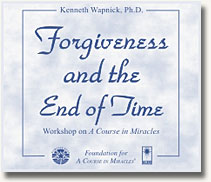
This section called “Forgiveness and The End of Time”  from the Text (Chap. 29, section VI) is a beautiful rendering of the pivotal theme of purpose recurring throughout the Course. Understanding purpose and how it is applied opens up the seeming secrets of the Course, specifically with regard to forgiveness as a theoretical principle, and more importantly as a principle that can guide us in our daily lives. This workshop thus helps us understand our world, our relationships, and our experiences in terms of the underlying purpose of the ego. Forgiveness begins with our asking Jesus to help us replace our pact with the ego with a vow to him no longer to be afraid of his love.


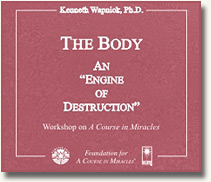
This 2007 workshop explores the two purposes for the body. The ego uses the body to fulfill its strategy of mindlessness, wherein the mind’s decision for the ego and its thought system of sin and destruction is hidden behind projection. Thus does the body become the engine of destruction that symbolizes the death of God and His Son. The Holy Spirit, on the other hand, shifts the body’s purpose from hate to forgiveness, so that it becomes the classroom in which we learn that nothing has occurred to change the sinlessness of God’s Son. As we choose again, the ego’s judgment becomes the Holy Spirit’s vision and we are healed.


Filed Under: Home Posts Tagged With: A Course in Miracles, ACIM, forgiveness, Peace, Purpose, SFACIM

Free Online Introductory Presentation on A Course in Miracles… using The Free App ZOOM… Mon. 8/3/20 @ 5pm Mt Time

June 15, 2020


Free Online Introduction to…

A Course in Miracles,

@ 5pm Mt Time

(4pm Pacific, 6pm Central, 7pm Eastern)

Next one:  Monday, 8/3/2020

All questions are welcomed and encouraged!

(using the free basic Zoom app)

————–

Because of inappropriate behavior and violent images (called zoombombing on the internet) by people invading Zoom meetings due to a public link, we will send a non-public link for this meeting…  please email us for that Zoom link if you don’t already have it …

Email us @ alyncorona@gmail.com… and tell us:

  •  your name,
  • your phone #, and
  • how long you have known about the Course 
  • what Course teachers (if any) you are familiar with

Brand new to A Course in Miracles?

Know someone who is new?

Would you like to have a meeting where you can tell your friends and acquaintances where they can go for an evening… for a free basic introduction to the Course?

Monday 8/3/2020

 5:00-6:00pm Mountain Time

(4pm Pacific, 6pm Central, 7pm Eastern, 8pm Brazil, 8am Tuesday in Sydney Australia)

 We will give a brief history of the Course, an overview of its three books, and an intro to its unique metaphysics and its non-traditional message of forgiveness. We will also introduce our School for ACIM and explain our programs.

You will be presented with an understanding of the Course’s goal of inner peace and the process to get there. And you will leave with a few simple ways to experience the Course’s idea of forgiveness.

Presented by facilitators from School for A Course in Miracles (sfacim.org).

Please come and check it out.

Everyone is always welcome.


A Course in Miracles:

Metaphysics 101

YouTube Chart Description Playlist:

click here


Filed Under: Past Classes and Events Tagged With: A Course in Miracles, A Course in Miracles Beginners Class, ACIM, ACIM Beginner Classes, forgiveness, Ken Wapnick, Peace, School for A Course in Miracles

Thursdays Online @ 10am-11:15 am Mt Time

April 10, 2020


The SFACIM Thurs. Online 10am Course Class:

“Thursdays” Online

All online classes are now 75 min. long.

10-11:15am Mt Time

Because of inappropriate behavior by people invading our meeting due to a public link, we will begin sending out a specific new link for our meetings… regretfully you will have to click here  to register for new link.


Also School for ACIM has classes now almost every day online throughout the current crises…

click here



Come and join us every Thursday,  for 75 minutes online at 10am USA Mountain Time… for a class about a selected major Course topic,  with its many wonderful insights into forgiveness… Tim Wise will give a brief presentation, while giving everyone time for questions and comments…

Our idea is to keep it informal and relaxed, open to both brand new folks to the Course and ongoing Course students alike.

*If you are brand new to the Course, or if you are not familiar with Ken Wapnick’s Chart on Course metaphysics, it is helpful to read over our SFACIM post (click here) on the chart before attending the meeting… or watch our “Welcome” video (click here)*

The Meeting: it’s all live, online streaming with the free app Zoom, right in the comfort of your own surroundings. No need to get dressed up and go anywhere.

Suggested online offering is $10 a meeting, $25 a month for Thursdays, $48 a month for all Tues., Wed., Thurs., & Sat. Online classes:

(or simply donate whatever you can to help School for a Course in Miracles keep classes going online… and if you can’t afford to donate, please come anyway…)


(click here to donate)


Participating students are encouraged to ask questions and occasionally share their own experiences that exemplify the topic. It is also suggested that they take advantage of the opportunity to simply be students again, to listen and learn and apply the Course teachings right there in class… no matter how many times they have heard or even taught the material themselves.


Video Streaming Tip:  

*It helps to be aware of front lighting on your face instead of back lighting when on streaming… Otherwise your face will be darkened and not see-able on the screen.  Thanks!


Bridge - Autumn Color

Any questions, concerns, or if you would like help downloading the Zoom app ahead of time to work out any kinks (usually there seem to be one or two that are easily manageable),  give Tim a call @ 720-391-9294. 


Filed Under: Past Classes and Events Tagged With: A Course in Miracles, A Course in Miracles Beginners, ACIM, ACIM Beginner Classes, forgiveness, Ken Wapnick, Peace, School for A Course in Miracles

Musings: The Five Laws of Chaos of The Ego

March 26, 2020


“The Five Laws of Chaos”


Discussed in Chap. 23 Sec. II of A Course in Miracles, these five chaotic “laws” are basically the laws or rules of the ego’s dismal war-game of separation, The War Against Yourself (your True Self).

They, the “laws,” are put in quotes because as Jesus says they are not real laws but are simply made up descending rungs in an illusionary ladder, where we attempt to become a ‘something else,’ other than God’s One Son.

The problem is, Jesus continues, that we really do believe in them… and don’t realize we do.

He also says that once the first law is set in motion the other four automatically follow, and that you can’t have or believe in any one of them without the rest. It’s like a super slippery sliding board, where once you start you can’t stop till you crash at the bottom, ie. into the world we think we’re in.

Another way to look at these laws (or stages in our process of establishing an alternate ego identity)…  is to review the Chart and see how these are the ego’s five steps that we seem to take away from our awareness and experience of our true Identity in Heaven. That separation and descent into hell is actually impossible to do (even tho part of us wants to believe we did), and the Course calls that fact that nothing really happened… the Atonement Principle.


of The Ego

————————–

Here they are in a nutshell:

The Laws of Chaos

The first three laws take place internally in us in what the Course calls the wrong mind:

1) “The truth is different for everyone.”

It is our belief in sin: Differences are real, and those differences are important! There is a hierarchy of illusions. (in defiance of the first miracle principle: there is no hierarchy of miracles.)

2) “Each one must sin, and therefore deserves attack and death.”

It is our belief in guilt: we did really sin, it was really terrible, and we will be punished.

3) “For if God cannot be mistaken, He must accept His Son’s belief in what he is, and hate him for it.”

It is our belief in fear: we make up a God that is as crazy as we are, and that we should be afraid of Him! For we believe that also He believes we have sinned (separated from Him), and He will  punish us for it.

But: we simply made up a God in our separated “image and likeness,” and then we told Him how He should think and feel, especially about us.

————

The 4th and 5th laws take place in the world (reflecting the first three laws of sin, guilt and fear in the mind… into all our worldly relationships):

4) “This seeming law is the belief you have what you have taken.”

Special hate relationships: In a savage world the kind cannot be kind. They must take or else be taken from, by others who are worse than themselves. The Course calls these our special hate relationships. 

5) “The final principle…holds there is a substitute for love (as crazy as it sounds, the Course calls this substitute: Fear!).”

Special love relationships: That substitute is hidden in my brother’s body and personhood, and he must be destroyed, in sometimes seemingly subtle ways… to get it back. We do this in disguise with the “face of innocence,”  a pretend niceness and disingenuous kindness, and without a real appreciation and awareness of the true innate Innocence of our brothers or ourselves.

I then ‘need’ you to show me your fear… that you ‘need’ me and are afraid that you will one day lose me, either thru abandonment, sickness, or death, and vice versa. (described in Ch. 31, Self-Concept vs. Self, p.656)

Ken Wapnick calls this substitute for love, not our true innocence as one Son of God, but the special innocence, special love or attention, that we as egos desperately need to sustain our individual made-up selves. To get this recognition of special innocence from others, we must cannibalize others to demand and ‘devour’ their time, energy, and regard. This process takes the form of the phony face of innocence … through manipulation, control, threat, and compromise.

—————

Even in the world of time and space, so called “life” must eat other “life” in order to survive and maintain itself. This is simply a projection of the first law of chaos. My truth, or identity, is different from God’s truth.

And in order to be different and separate from our Father in Heaven, we believe we had to sever (kill) our connection with Him and steal (eat) a piece of His Life and run away with it. Thus the ego’s laws come full circle in the fourth, and especially fifth law of chaos… the special love relationship, the ego’s most boasted weapon. (Text p.341, par. 3).

I take, bargain, compromise with you… whatever it takes to get from you what I think i need… attention, esteem , ‘love,’ etc. in order to maintain and feel better about my chosen belief in this ego self.


Jesus tells us in Chapter 23:

18 “You would maintain, and think it true, that you do not believe these senseless laws, nor act upon them. And when you look at what they say, they cannot be believed.

Brother, you do believe them.

For how else could you perceive the form they take, with content such as this? Can any form of this be tenable? Yet you believe them for the form they take, and do not recognize the content. It never changes. Can you paint rosy lips upon a skeleton, dress it in loveliness, pet it and pamper it, and make it live? And can you be content with an illusion that you are living?

19 There is no life outside of Heaven. Where God created life, there life must be. In any state apart from Heaven life is illusion. At best it seems like life; at worst, like death. Yet both are judgments on what is not life, equal in their inaccuracy and lack of meaning. Life not in Heaven is impossible, and what is not in Heaven is not anywhere. Outside of Heaven, only the conflict of illusion stands; senseless, impossible and beyond all reason, and yet perceived as an eternal barrier to Heaven. Illusions are but forms. Their content is never true.”

(par. 18-19 p. 493)

—————–

Think about these laws and notice your reaction to them. Do they even seem credible?

Does any one of them particularly stand out?

How would you describe each of them in your own words?


The Laws of Chaos [CD]

For further discussion of the “Laws of Chaos”…  what they mean, how they play out in our special relationships, and most importantly how they can be acknowledged and released… listen to Ken Wapnick’s  CD set or MP3 download @ facim.org,

or read Ken’s comments in his insightful discourse “Journey through the Text,”  Volume Three, p. 213-220…

or see the SFACIM video on the Laws of Chaos: click here


Filed Under: Home Posts Tagged With: A Course in Miracles, ACIM, Chaos, forgiveness, Ken Wapnick, Laws of Chaos, mind training, Peace, perception, School for A Course in Miracles, SFACIM

The Ego Pandemic in Our Mind … and The ‘Vaccine’ : Forgiveness

March 11, 2020


A Forgiveness Refresher:

The Functional Solution to

The Belief in Virus, Disaster & Death in Our Mind

(click arrow below for replay of podcast)

Forgiveness: The Antidote for All Belief in Sickness 

March 5, 2020

Tim uses Lessons #61-66 to describe how we use forgiveness to save the world from our own judgment & condemnation.

A Course in Miracles points out over and over how all sickness and disease and death in the world is simply a reflection of our own internal belief in separation from God. (It takes about two minutes into the recording to get past the background noise.)

Like Download


“The Real Virus:”

In this post we have replaced the word “problem” in Lesson 79 with the specific problem/issue of “sickness,” to present how the Course approaches all sickness in the world (including the coronavirus) as a reflection of the one and only perceived sickness in our mind: our belief in separation from Our Father in Heaven.

————————————–

“A Course in Miracles” Workbook Lesson 79 (p.141):

“Let me recognize the sickness (of belief in separation in my mind) so it can be healed.”

A sickness cannot be healed if you do not know what it is. Even if it is really healed already you will still have the (original and only) sickness, because you will not recognize that it has been healed. This is the situation of the world. The sickness of (belief in) separation, which is really the only sickness, has already been healed. Yet the healing is not recognized because the sickness is not recognized.

Everyone in this world seems to have his own special form of illness(es). Yet they are all the same, and must be recognized as one if the one solution that heals them all is to be accepted. Who can see that a sickness has been healed if he thinks the sickness is something else? Even if he is given the answer, he cannot see its relevance.


That is the position in which you find yourself now. You have the answer, but you are still uncertain about what the (real) sickness is. A long series of different sicknesses seem to confront you, and as one is settled the next one and the next arise. There seems to be no end to them. There is no time in which you feel completely free of some kind of illness and at peace.

The temptation to regard sicknesses as many is the temptation to keep the sickness of separation unsolved. The world seems to present you with a vast number of illnesses, each requiring a different answer. This perception places you in a position in which your healing of sickness must be inadequate, and failure is inevitable. (Just believing we are a body, healthy or not, is sick, projected from the unhealthy but made-up belief in our mind that we are separated from Our Father in Heaven.)

No one could solve all the sickness the world appears to hold. They seem to be on so many levels, in such varying forms and with such varied content, that they confront you with an impossible situation. Dismay and depression are inevitable as you regard them. Some spring up unexpectedly, just as you think you have resolved the previous ones. Others remain unsolved under a cloud of denial, and rise to haunt you from time to time, only to be hidden again but still unsolved.


All this complexity is but a desperate attempt not to recognize the (real and only) sickness (believing we are separate minds, projected onto separate  bodies, healthy or not), and therefore not to let it be resolved. If you could recognize that your only sickness is separation (in the mind), no matter what form it takes (as healthy bodies or sick bodies), you could accept the answer because you would see its relevance. Perceiving the underlying constancy in all the sicknesses that seem to confront you, you would understand that you have the means to solve them all. And you would use the means, because you recognize the problem.

In our longer practice periods today we will ask what the (real) sickness is, and what is the answer to it. We will not assume that we already know. We will try to free our minds of all the many different kinds of ’sick’ we think we have. We will try to realize that we have only one sickness, which we have failed to recognize. We will ask what it is, and wait for the answer. We will be told. Then we will ask for the solution to it. And we will be told.

The exercises for today will be successful to the extent to which you do not insist on defining the sickness. Perhaps you will not succeed in letting all your preconceived notions go, but that is not necessary. All that is necessary is to entertain some doubt about the reality of your version of what your sicknesses are. You are trying to recognize that you have been given the answer by recognizing the problem (in the mind), so that the problem and the answer (the Holy Spirit tells us the our belief in separation is silly) can be brought together and you can be at peace.

The shorter practice periods for today will not be set by time, but by need. You will see many forms of sickness today, each one calling for an answer. Our efforts will be directed toward recognizing that there is only one sickness (belief in the ego) and one healing (The Holy Spirit). In this recognition are all sicknesses resolved. In this recognition there is peace.


Be not deceived by the form of sickness today. Whenever any forms of sickness seem to rise, tell yourself quickly:

Let me recognize the only sickness is in my mind so it can be healed.

Then try to suspend all judgment about what sickness is. If possible, close your eyes for a moment and ask what it is. You will be heard and you will be answered.


Video replay on dealing with CORONAVIRUS & OTHER DISASTERS…


For a two disc CD seminar or MP3 download

on sickness & healing,

see Ken Wapnick’s

“The Kindness of Healing”…

The Kindness of Healing [CD]

click here


SFACIM Online Course Meetings

… almost every day!

To help get us thru the “crazies,” in these current times…

click here



Filed Under: Home Posts Tagged With: A Course in Miracles, ACIM, forgiveness, Peace, Problems, SFACIM

Musings: The Four Obstacles to My Peace of Mind

March 6, 2020


The Obstacles to Peace  

(Chapter 19, Section IV, p. 406-424)

The Course tells us that there are basically four obstacles to finding our true peace of mind…

(with four correlating subheadings, delineated by an “i”):  


A. The Desire to Get Rid of It (Peace)

          i. The Attraction of Guilt

B. The Belief the Body Is Valuable for What It Offers (A place for our projected guilt, seen as the body’s pain or pleasure)

         i. The Attraction of Pain

C. The Attraction of Death (not just death of the body, but belief in the idea of death)

        i. The Incorruptible Body

D. The Fear of God (The fear of Love, the fear of sinlessness)

        i. The Lifting of the Veil


The Titles Themselves

The first striking thing hits us as we begin to look at these titles above!

Jesus is telling us that the very qualities or feelings that we are attracted to… are not peace, not joy, and not love.

In our make-believe separated state, he literally says we are attracted to their opposites: we are really attracted to guilt, to pain, and to death. These unrecognized attractions to terrible stuff are three of our main obstacles to peace.

For many of us, is that even in our awareness? Do we really believe that?

But, what if it’s possibly true though?… How often have we tried at peace, love, or joy, and seemed to miss the mark? Or even if we felt them temporarily, the other shoe eventually dropped. What if just below our seeming conscious desires for peace and love… something else is going on in our minds. What if we are really trying to push real peace and love away? What if we are not upset, or attracted, or whatever, for the reasons that we consciously think? (WB Lesson #5)

————————

Then there’s the title of the fourth obstacle, “The Fear of God!” So it gets worse… even more insulting to our egos. Not only does Jesus tell us we are attracted to some real nasty things like pain and death, but then he says that what we are really fearful of isn’t the bad stuff, to which we are attracted, but God Himself. He says that we are not really seeking for God’s Love, but we have actually convinced ourselves we are afraid of It.

So once again is that possible? Is the Course correct, as the country western song laments… we are “lookin for love in all the wrong places”…  because we are truly afraid to find it?


The Four Grand Self-Deceptions (Obstacles)

One way of looking at the four obstacles and their order is to review our Wapnick Chart and the Course’s story of how we got here in the world (or at least believing that we’re here)… and then we retrace the steps of our descent into the hell of the world (and the self-imposed obstacles to our return to Heaven), starting with where we think we are now:

  1. We believe are bodies in a world, very vulnerable to the both physical and emotional attacks of others… obviously a not very peaceful state of existence to say the least. But it doesn’t look or feel like something we inwardly chose to be in. But what if it’s true, that my ego internal choice is constantly choosing to perceive a a state of conflict, so I can blame my lack of peace on someone else, and not realizeI chose it. And thus my desire to get rid of peace for that very purpose.  And so what if it’s true, that I’m never feeling un-peaceful or upset for the conscious reason I think, that it’s somebody else’s fault?  (See Les. # 5)
  2. The convincing, convicting, and conniving guilt we made-up in our minds is projected (misplaced) onto the body, especially others bodies guilty of what they did to mine. The ‘proof’ lies in all the seeming pains and pleasures of our bodies: the belief that the body is valuable for what it offers (guilt galore!). We made up a universe of time and space with many individual bodies for this purpose. Yes I feel pain or pleasure, but it’s seems to be coming from something external to my personality and my body.We believe our pain comes from what other bodies are doing to us (or even what our own body is doing), but we never admit the pain might be coming from the source of guilt in our mind… thus “the attraction of pain.” The body’s seeming pain in the body keeps us distracted from pain’s real source, the guilt within which was made up to prove our separation from Peace. The body’s seeming pleasure (special love) is simply a set up to place the internal guilt on someone else when the special love eventually fails and seems to now be our source of pain.
  3. And then the most insulting attraction of all… what Jesus calls our “dedication to death.” The internal belief in a spiritual death (the end of ourselves as spirit at one with our Heavenly Father) is now projected onto the death of our bodies with which we identify. It is the ultimate ‘proof’ that we left Heaven’s peace. There is and can be no death in heaven, only eternal Life at one with Itself. However once again, from a body’s point of view, our belief in death does not seem to be our choice nor our fault. We tell ourselves that we were born into bodies that simply die…we didn’t choose to do that… it just happens, or worse we blame it all on God. We believe death is real, but of course we don’t want to believe we are  actually attracted to it, much less responsible for making the idea of it up in the first place. Death once again proves we pulled off the impossible, and left Heaven.
  4. Finally, back to the ego’s beginning, the tiny mad idea of separation… We, identifying as a separated self (the ego), convince ourselves that we are now afraid of God. On one level we tell ourselves that He is going to punish us (ultimately with death, then hell) for what we did, i.e. leave Heaven. However on a deeper level, the Course tells us that we are not actually afraid of God’s wrath, but that we’re really afraid He’s not upset at all… because nothing really happened. That means no individual us, no bodies, no nothing… everything we think we are, believe in, and seem to react to, all nothing. Jesus constantly reminds us that we couldn’t and didn’t leave our true Identity in Heaven, even if some part of us seemed to want to. Chapter 13 (p.242, par.1-2) clearly tells us:

“You are not really afraid of crucifixion (we think crucifixion is the payment God demanded of His Son). Your real terror is of redemption.” The Atonement principle says separation didn’t and couldn’t happen. God’s experience of love and oneness in Heaven with His Son, which is our only true Identity,  does not include or know any experience of a separated state.


It does all sound like Star Wars: In a time long long ago and in a galaxy far far away, we seemed to step outside of our true reality in Heaven and play around with the ‘tiny mad idea’ of being separate from Heaven’s Peace…in other words we toyed with “our desire to get rid of peace.” This started the ego’s make-believe ballgame of separation rolling… To insure believing we actually did separate and did leave our true state of peace, we then made up the feelings of sin, guilt, and fear…thus  feelings which ‘prove’ to ourselves we did a really bad thing and did separate from our Father in Heaven. And then all that awareness was repressed, ‘forgotten,’ and the responsibility for our own lack of peace projected onto something or someone in the world.

It seems like we did this in some distant past, but we would be having a true experience of peace right now, if we were not still putting up theses unacknowledged blocks to our awareness right this moment. We need to work on this because it is happening right now.

—————————

Moving through and undoing (with the HS help) the four obstacles to peace are basically the letting go of believing ego’s story of the unholy trinity in our wrong mind: sin, guilt, and fear, that we told ourselves and accepted as reality:

1. sin (we threw Our True Identity as God’s One Son away),

2. guilt (the made-up pain we feel for doing just that, then projected onto the body and its ultimate death), and

3. fear (consciously of God’s punishment, but really of God’s Love)

So, through the process of forgiveness, we look at and uncover each of these stages (obstacles) and become willing to let each one go, not by ourselves, but with of ‘course’ the help of Jesus, or the Holy Spirit, by our side.


The Way Back:

The ACIM Forgiveness Process

The question that Jesus recommends that we learn to ask of the Holy Spirit, about anything is…”what is it for?”

From the ego’s point of view the purpose of our obstacles to peace are just that… self-chosen obstacles that are kept out of our conscious awareness, so it looks like we are running after and chasing peace, when we really are not… the Course says our self-accepted ego mantra becomes “Seek but do not find.”

The Holy Spirit’s reverse purpose, for the obstacles we made up, is to…

1. look at and acknowledge them

2. see their insanity, and the pain (the cost) for believing in them to maintain a separated identity in something that we’re not, and

3. be willing to ask for His help in seeing beyond those obstacles to the “real world” (an experience that our innocence and our brothers’ innocence is still intact, despite what we think we see and hear…)


The Starting Place

Two of the major themes that Jesus develops throughout this entire section (and especially in the section’s intro and the ‘Lifting of the Veil’ at the end) are that the way we move through and beyond each and every obstacle is…  

With the Holy Spirit’s help, to have a Holy Relationship with the Holy Spirit in our minds. This then is reflected in our relationships with all our brothers.

He tells us that the first step in connecting with the Holy Spirit’s help is always to ask ourselves… are we willing to look past our judgements of each other, with His Help, to see the true innocence within? This begins the “Lifting of the Veil” of our belief in sin, guilt, and fear, and is specifically spelled out in the Text on p.421, par.8, line 7:

“But first, lift up your eyes and look on your brother in innocence born of complete forgiveness of his illusions, and through the eyes of faith (the HS) that sees them not.”

With each obstacle to peace, we used our brother’s body, personality, and actions as a scapegoat for our own inner choice to get rid of peace, and then blame our guilt and pain on him. To recognize that, by asking for the Holy Spirit’s help, is the only way back in in letting go of each of these obstacles to peace, these “blocks to the awareness of Love’s presence,” that we ourselves put there and then denied. (see the Course’s Introduction on p.1 in the Text)

Another way Jesus describes as the way to start this process is in the Text, p.441, par.9. He tells us don’t even ask how to see my my brother or myself without a body… but am I willing to see past my judgements and have an experience of his and my guiltlessness, the process of true forgiveness. (Click here for explanation of forgiveness in ACIM.)

Your question should not be, “How can I see my brother without the body?” Ask only, “Do I really wish to see him sinless?”… forget not that his sinlessness is (also) your escape from fear.

The second step in the process is…  am I willing to see beyond my own seeming guilt for having thrown Heaven away? The same way I was willing to forgive my brother for what he did not do (cause me pain), am I willing to ask  Jesus for help…  to let go of believing I left him and my Father in Heaven for something else (a separate identity)? He did not go anywhere. And I simply pretended  I did.

What if all that seeming separation is just not true? 

Not recognizing that that has been my problem all along… not that I actually did separate from what I/ we truly are, but I only convinced myself I did. And then to ask for help to let that silly belief go “back into the nothingness from which it came.”

And then I begin to realize: that each of the obstacles to my peace of mind that seemed like real obstacles were never there, and were all made up.


For further discussion of the “Obstacles to Peace,” see Ken Wapnick’s CD set or MP3 Download on “Lifting of the Veil” 

————-

or Ken’s “Journey through the Text,” Volume Three, p.78-92.


Filed Under: Home Posts Tagged With: A Course in Miracles, ACIM, ACIM Beginner Classes, forgiveness, Obstacles to Peace, Peace, perception, School for A Course in Miracles, SFACIM

  • « Previous Page
  • 1
  • 2
  • 3
  • 4
  • …
  • 8
  • Next Page »

Search A Course in Miracles topic or class on this website: Type your search here & then hit “Enter”

Help School for ACIM Provide Our Weekly Online Classes on The Study & Practice of ACIM


ONLINE Weekly SFACIM Classes:

Thursdays @ 5:30pm Mt: Discussions of FACIM Books on ACIM (next book starts soon: “The Transformed World & The Thunder of The Meaningless”)

SFACIM Online Classes & Discussion Sessions Schedule (thru June 2026)

ZOOM Link for Weekly SFACIM 90 Minute Classes… and 75 Min. Discussion Sessions

After first two weeks of donation-free classes: Suggested monthly donations to continue access to weekly live online classes… and also receive link for SFACIM Video Library with hundreds of Class Replays

Sundays: 9:30am Mt. on The ACIM Text (90 min.)

Sunday ACIM Sessions with Lyn @ 6pm Mt

Mondays: Zoom Discussions (75 min.) on ACIM @ 9:30am Mt. … & … Classes on the BIG Workbook Lessons 181-200 (90 min.) @ 5:30pm Mt. Time

Tuesdays Online: “Together on The Resurrection Road” 10-11:30am Mt.

Wed. Gathering of Men: Online ACIM Men’s Discussion Group @ 5:30pm Mt.

Fridays: 75 Min. Zoom ACIM Discussion Sessions on Current Workbook Lessons @ 9:30am Mt

Saturdays @ 9:30am Mt. on “The Clarification of Terms”

Some Recent SFACIM Class Replays…

New Classes & Upcoming Events:

SFACIM Classes on These Supplements to ACIM: Fri.  2/27  @ 9:30am Mt     we begin The Song of Prayer on Fridays  (with Marisa)…  Sat.   2/28  9:30am Mt     we begin Psychotherapy Pamphlet Intro & Ch 1 “Purpose”  on Saturdays  …  Sat.   5/23   9:30am Mt     we begin Gifts of God Prose Poem (p. 115-118): […]

Please join our current Thurs. series… you can come try it at any time and see if it ‘works’ for you.  Ken Wapnick book discussion on Thursday Evenings @ 5:30pm Mountain Time Beginning August 14, 2025 we will begin discussing, with Maya,  Ken Wapnick’s book:   Next: on/or about March 5, 2026 the Thursday night […]

Online Class Guidelines: “Please Have Your Video Camera on During Class!” Please have your video camera on during our 90 min. classes, and our free 75 min. sessions,  so we can see each others’ faces… except for times when: 1) you are eating, or 2) you may need to move around during class, or 3) […]

  Sunday ACIM Sessions with Lyn @ 6pm Mt   75 min. sessions,  free and unrecorded. our resting together in the stillness… with some discussion, selected  readings and some quiet time. For complete SFACIM weekly Schedule, and for Zoom link if you do not already have it,  click here

  Beginning Jan. 2nd, 2026,  on Saturdays @ 9:30am Mountain Time… we start reviewing and discussing The Clarification of Terms in the Manual for Teachers, section by section… these Zoom sessions  are about 75 min. long, free and unrecorded. On Sat. Feb 28 we begin the Psychotherapy Pamphlet:  


Announcements:

Two New SFACIM Classes Start Fri. 2/27 on The Two “ACIM” Supplements: Psychotherapy and Song of Prayer… and later ‘The Gifts of God Prose Poem’ in May 2026

Thursdays @ 5:30pm Mt: Discussions of FACIM Books on ACIM (next book starts soon: “The Transformed World & The Thunder of The Meaningless”)

Beginners: New or Fairly New to A Course in Miracles?

SFACIM Online Classes & Discussion Sessions Schedule (thru June 2026)

Sunday ACIM Sessions with Lyn @ 6pm Mt

Our Current SFACIM Email Address…

All Course quotes are from A Course in Miracles, copyright ©1992, 1999, 2007 by the Foundation for Inner Peace, 448 Ignacio Blvd., #306, Novato, CA 94949, ACIM.org (Contact), used with permission.

Site Map · Copyright © 2025 · Lyn Corona
customized by Intent Design Studio (editor of ACIMblog.com) · hosted by BlueHost · WordPress