• Home
  • Faculty/Ark of Peace
    • New to A Course in Miracles??
    • SFACIM Dedication, Mission, and Vision (under nonprofit “Ark of Peace”
    • Our Teachers
    • The Teacher-Pupil Relationship
    • The Community of Love
    • Ark of Peace Nonprofit Org. (Includes SFACIM)
  • ACIM
    • How It Came
    • What It Is
    • What It Says
    • Foundation for A Course In Miracles (FACIM)
  • Classes/Events
    • SFACIM Daily Calendar of Classes & Discussion Sessions on Zoom
    • Recommended for Newcomers
    • Ongoing Classes
    • Past Classes and Events
  • Resources
  • Musings
    • Lyn Corona
    • Conversations with Ken Wapnick
  • Free Mentoring Sessions

School for A Course In Miracles

"The universe of learning will open up before you."

School for A Course In Miracles

“The universe of learning will open up before you in all its gracious simplicity.” T-14. II. 6:4
  • Beginners: New to “A Course in Miracles?”
  • Audio
  • Video
  • Topic Index
  • Contact SFACIM
You are here: Home / Archives for Home Posts

Our Ego Need to Believe That Innocence is Slain…

December 1, 2021


With the recent shootings in the States, and the killing and displacement of families in the wars in Ukraine and Gaza and Iran,

and all the seeming horrendous death and destruction happening now in the world everywhere… how do we approach this apparent senselessness from a Course point of view, and how do we deal with that and any worldly turmoil… internally in each of us ?

Here are  a couple SFACIM video replays on what our invulnerable true innocence looks and feels like as One Son of God…. and the ego’s bottom line need to believe we crucified our own true innocent Identity.

We then discuss… how that plays out in the world, and how do we recognize and then let go of our belief in our ego need for enemies, murder and judgment? (Ch. 23, Sec. III & IV, in the Text)

——————–



Filed Under: Home Posts

Happy Thanksgiving: Be grateful! Our sinlessness is an… “Already-Done-Deal !”

November 22, 2021


Our own redemption is already at hand, and unless you give all that you have received you will not know that you have awakened with him, your brother… already.        

(Text p.209, par. 9)

One of the striking differences between ACIM and traditional Judeo-Christian beliefs and most New Age spiritualities is that…  A Course in Miracles takes an ‘already-done-deal’ approach.

Most western religious and spiritual paths assume something is really wrong to begin with, and then go about trying to fix it or evolve beyond it. To them, sin and separation are devastatingly real. The Course specifically sets up its version of the Atonement (that nothing happened), right in its Introduction to the Text on page 1.

This Intro immediately spells out that this is not a course about love, loving, or evolving somehow towards love, or even making the world a better place in which to live… but on letting go of our own judgements of others and ourselves which block our awareness that we are still beings of Love:


“The course does not aim at teaching the meaning of love, for that is beyond what can be taught. It does aim however at removing the blocks to the (our) awareness of love’s presence, which is our natural inheritance.” (Text, p.1)

So then, this is simply a course about undoing those blocks, in our minds, to realizing that love is already a done deal, and our true Identity is still part of that Love… period. We are God’s children, always have been, always will be. The Course shows us how to stop pretending that we’re not eternally part of God’s Love… insisting in our criticizing, fixing, and sometimes even ‘helping,’ that we are not ‘still’ as God created us.

“But when I willingly and gladly go the way my Father’s plan appointed me to go, then will I recognize salvation is already here, already given all my brothers and already mine as well.” (Les.#317)

So what’s my Father’s plan? In the Course’s 1300 plus pages, Jesus is always encouraging us to look at each other differently by asking the Holy Spirit for help ‘to see beyond the veil,’ see beyond the differences we think we see and even cherish. Early on in the Course he also states that this course is not about behavior (Text p.29, par.2-3). It is not about what we do or don’t do, but about how we “see” each other.

And more to the point: with whom are we seeing or perceiving… our ego or the Holy Spirit? Jesus tells us we have this internal place called the mind, where we are constantly choosing between one of these two teachers or inner guides. (NB: This internal place is not what the world calls our brain, but a deep place within us the Course describes as the ‘mind.’) When we choose the ego as our teacher, we see separation and blame. When we choose the Holy Spirit, we experience the Atonement, that nothing happened and our true Identity is still intact.

Problem is, when we are choosing the ego, we’re not really conscious of that choice… but we do feel its effects. We are irritable, judgmental, and certainly not peaceful. We are quick to point out that our discontent is not our responsibility, but we easily finger-point the culprit as something or somebody else. It’s amazing when we go thru the course of our day, and begin to realize… how many times each and every day we are blaming, and how much we are on high alert to find a new drama where we can find and accuse others of robbing us of our peace.

However, choosing to ask the Holy Spirit to perceive and experience people and things differently is a very conscious and vigilant effort. We first honestly look at how hateful our thinking and seeing is, and even tho we believe we are right, we admit how painful it is to hold onto that righteousness. (Would I rather be right or happy?) This becomes the motivation to hope that ‘there must be a better way,’ and I begin to be a little more willing to find and try that ‘better way’. The better way for Course students is the Course’s process of forgiveness, ie. learning to ‘see’ differently. We forgive, or let go, of our way of viewing the world full of victims and victimizers. Then we allow, or let, the Holy Spirit’s vision, of what we truly are, take its place.

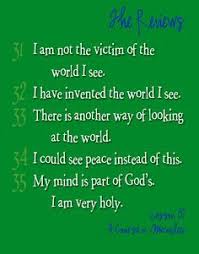
(Lesson Titles #31-35)

Forgiveness in the Course is a return to the awareness of the “Done Deal.” Whatever our eyes might be telling us, we ask for the Holy Spirit’s gift of vision to see/experience that our brother’s innocence (and ultimately our own) is still intact… already there and present, no matter what they are doing or not. This doesn’t mean, in terms of behavior, that we don’t do the next appropriate and helpful thing. But it does mean that while we are doing whatever our chosen behavior is, in our heart of hearts, we come to know we are each already ok, already saved, and already God’s one Son.

This is not some pie-in-the-sky made up fantasy. For those of us who have practiced the Course’s forgiveness, we experience that this is the reality behind all the seeming facades that ’cause’ us to blame and condemn. We actually begin to feel and know, about ourselves and others, what Jesus consistently tells us in Lessons #201 thru 220:

“I am not a body. I am free. I am still (already) as God created me.”

Thank you Jesus!

and Happy Thanksgiving!


Replay of video from SFACIM on a discussion of “gratitude”:

click here


Also a five minute youtube clip on Ken Wapnick speaking about our gratitude to Jesus for giving us his Course in Miracles:

Click here


Coming soon…

Five Month Online

The Immersion 2026

click here for info


Filed Under: Home Posts Tagged With: A Course in Miracles, ACIM, ACIM Beginner Classes, forgiveness, Ken Wapnick, Peace, SFACIM

Rosemary Stevens: Our True Friend… always and in all ways!

November 6, 2021

….and dearly beloved sister of Jesus, made her transition into Jesus’ loving arms on Tuesday Nov. 4th, 2025.


Abby Steven’s (her blessed sister) comments:

Hi Tim,

Dropping you a line to let you know that yesterday, Rosemary passed peacefully and with lotsa love surrounding her.
She had had a diagnosis in 2020, of pulmonary fibrosis, a progressive disease, for which there is no cure.

As a 30+ year student of the Course, she had ALMOST all of Ken’s CDs, cassettes and many of his books…
Actually that was all she read, and that constituted her entire “library”.

Hugs 🫂 & Blessings 🙌🏻 as always, Abby❣️


Almost a year ago now, and highlighting Rosemary’s lovely dedication to Jesus and his Course, and Ken and his teachings, and also her wonderful sense of humor…

Rosemary lead this class on WB lessons 343-349 on Dec. 4, 2024:

https://tinyurl.com/28m4j3mt


Filed Under: Home Posts

Musings… The Atonement: What’s that?

October 27, 2021


ATONEMENT ?

In traditional Christian terms, atonement is the reconciliation of God and humankind through the sacrificial death of Jesus Christ (usually perceived as needed because… due to Adam & Eve’s sin, mankind was forced out of Heaven).

But Atonement in A Course in Miracles (ACIM) is something totally different. Atonement in the Course is ‘waking up’ and realizing that sin (separation from God) couldn’t happen, and never happened, and God’s Son never separated from His Father.

Early on in the ACIM Text, Atonement is first mentioned and described in Chap. One Sec. I, in the fifty Miracle Principles (#25, 26, 33, 34, 37, 44).

Jesus says this in principle #25…  Miracles are part of an interlocking chain of forgiveness which, when completed, is the Atonement. (Text, p.4) Forgiveness in the Course is always referred to as an opportunity to let go of our belief that someone is guilty or sinful, including ourselves.

Jesus then goes on to talk about and use the word Atonement more than 250 times in the Course.

Ken Wapnick, in his Glossary-Index for ACIM, calls the Atonement… the Holy Spirit’s plan of correction to undo the ego and heal the belief in separation. The idea of Atonement came into being after our seeming separation from Oneness, and will be completed when every separated Son has fulfilled his part in the Atonement thru total forgiveness. Its principle is that the separation never occurred.

Emphasis then is on the last sentence. Since the separation from God never happened, the Atonement becomes a series of wake-up experiences (the Course calls them miracles) to the inevitable understanding that this is true. We never disconnected from our Father in Heaven or separated from each other. The tiny mad idea of separation was just that… It was tiny and made-up, not to mention crazy, but ultimately just silly.

Another way of defining Atonement is that ‘nothing happened,’ i.e. there was no separation.  Jesus uses that phrase a number of times throughout the Course:

—————-

Nothing happened!

“Nothing unreal exists.” (Text Intro, p.1)

11 “The ego can accept the idea that return is necessary because it can so easily make the idea seem difficult. Yet the Holy Spirit tells you that even return is unnecessary, because what never happened cannot be difficult. However, you can make the idea of return both necessary and difficult. ” (Ch. 6, sec II, par.11. p.98)

“Such evident inconsistencies account for why no one has really explained what happens in psychotherapy. Nothing really does. Nothing real has happened to the unhealed healer, and he must learn from his own teaching. His ego will always seek to get something from the situation.” (Ch.9, sec V, par.5, p.172)
“… recognize that what has no effects does not exist. Laws do not operate in a vacuum, and what leads to nothing has not happened. If reality is recognized by its extension, what leads to nothing could not be real.” (Ch.11, sec V, par.2, p.203)
“For if you accept your invulnerability, you are recognizing that attack has no effect. Although you have attacked yourself, you will be demonstrating that nothing really happened. Therefore, by attacking you have not done anything. Once you realize this you will no longer see any sense in attack, for it manifestly does not work and cannot protect you.” (Ch. 12, sec V, par. 2, p.203)

4 “Nothing at all has happened but that you have put yourself to sleep, and dreamed a dream in which you were an alien to yourself, and but a part of someone else’s dream. The miracle does not awaken you, but merely shows you who the dreamer is… The miracle does nothing but to show him that he has done nothing. What he fears is cause without the consequences that would make it cause. And so it never was.” (Ch.28, sec II, par. 4 & 7, p.593-594)

1 Today we will anticipate the time when dreams of sin and guilt are gone, and we have reached the holy peace we never left. Merely a tiny instant has elapsed between eternity and timelessness. So brief the interval there was no lapse in continuity, nor break in thoughts which are forever unified as one. Nothing has ever happened to disturb the peace of God the Father and the Son. This we accept as wholly true today.” (Les. #234. p.409)

——————————

Jesus also repeatedly tell us…

 The sole responsibility of the miracle worker is to accept the Atonement for himself. (Ch.2, sec V, par.5, p.25)

The teacher of God takes accepting the Atonement for himself as his only function.  (Man. #22 par.1, p.55)


If thats true , then how do each of us go about accepting and implementing  in our own lives this plan of Atonement? Two key elements of the process are pointed out here in sec IV of Ch.9… The first is our willingness to let go of our judgements of each other and ourselves, and the second is to ask the Holy Spirit for help to see beyond those judgements and have a different experience of all our brothers and ourselves…

 The Holy Spirit’s (Atonement) Plan of Forgiveness…

in Chapter 9:

1 Atonement is for all, because it is the way to undo the belief that anything is for you alone. To forgive is to overlook. Look, then, beyond error (judgment and condemnation) and do not let your perception rest upon it, for you will believe what your perception holds (sees). Accept as true only what your brother is (a guiltless Son of God), if you would know yourself. Perceive what he is not (a sinner) and you cannot know what you are, because you see him falsely. Remember always that your (True) Identity is shared, and that Its sharing is Its reality.

2 You have a part to play in the Atonement, but the plan of the Atonement is beyond you. You do not understand how to overlook errors (your judgments), or you would not make them. It would merely be further error to believe either that you do not make them, or that you can correct them without a Guide to correction (Jesus or the Holy Spirit). And if you do not follow this Guide, your errors will not be corrected. The plan is not yours because of your limited ideas about what you are. This sense of limitation (the tiny mad idea of separation) is where all errors arise. The way to undo them, therefore, is not of you but for you. (sec IV of Ch.9, par.1-2, p.168)


—————————


 Atonement in the Course is not the atonement definition for many new age thinkers, where atonement means at-one-ment. The Atonement in the Course however is a process of waking up. It is realizing that we can and will forgive our brothers and ourselves… not because our sins are real and need to be forgiven. But we begin to see and experience the unreality of those sins and let go of our need for retribution. (At-one-ment in the Course would be the experience of our Oneness in Heaven that is our True Identity… which is what we return to when we complete the Atonement process of forgiveness in the Course.)

This profound process of moving through the three steps of forgiveness outlined in the Course is the way to fulfill God’s Plan of Atonement in our lives. We atone for our own seeming sins and the sins of others, not through martyrdom or sacrifice, but by having the very real experience that all our innocence as One Son of God is still intact, no matter what we or others seem to have done… this is not a whitewashing of sins, but simply a realization that ‘nothing happened. Our true AT-ONE-MENT is still who and what we are in Heaven. Our ‘job,’ our only function, is to stop insisting that that is not our true reality…


Check out Lyn’s Video on

“Whispering to The Atonement”

https://www.youtube.com/watch?v=aRza8PlK4dc&t=15s


Ken Wapnick’s 5 min. description of  “Atonement:”


Ken’s Seminar on “Atonement without Sacrifice:”

Atonement without Sacrifice [MP3]

click here for Mp3 download


Six Month Course Immersion One Program

(especially designed for both beginning and ongoing Course students)

Online… using free Zoom app

January- June 2023

(click here)


Filed Under: Home Posts

Musings: The Seven “Rules” of Decision Making

August 1, 2021

From ACIM Chapter 30, Sec. I

Text p.625-628:

RULES FOR DECISION

1. Upon waking think about the kind of day you want. The outlook starts with this: “Today I will make no decision by myself.”


2. Throughout the day reflect upon the kind of day you want and say, “If I make no decisions by myself, this is the day that will be given me. ”

These two procedures, practiced well, will serve to let you be directed without fear, for opposition will not first arise and then become a problem in itself.


3. When you have judged already (be certain this has happened if you feel yourself unwilling to sit by and ask to have the answer given to you), you need a quick restorative before you ask again. Therefore say, “I have no question, I forgot what to decide.” Try to observe this rule without delay, despite your opposition.


4. If you are so unwilling to receive you cannot even let your question go, you can begin to change your mind with this: “At least I can decide I do not like what I feel now.”


5. Continue with: “And so I hope I have been wrong.” This works against the sense of opposition.


6. You are not coerced, but merely hope to get a thing you want. And so you say in perfect honesty, “I want another way to look at this.”


7. The final step is but acknowledgement of lack of opposition to be helped. It is a statement of an open mind, not certain yet, but willing to be shown: “Perhaps there is another way to look at this. What can I lose by asking?”


“It must be clear that it is easier to have a happy day if you prevent unhappiness from entering at all. But this takes practice in the rules that will protect you from the ravages of fear.”

(Text p. 628, par. 13)


RULES FOR DECISION

( how to stop investing in my judgments)

… paraphrased:

1. Today I will make no decision (judgments) by myself…

I will ask now the Holy Spirit to help me see you and me and others… the way He does.

—

2. When I make no decisions or judgments by myself,

this is the peaceful day that will be given me.

—

3. When I get ‘crazy’ again, I have no question…

I forgot to decide  (to ask the HS to be my Guide in my perception).

—

4. At least I can realize and admit I do not like the way I feel now.

—

5. And so I hope I have been wrong.…  because leaving the HS out did not help.

—

6. I still really do want another way to look

at this situation or person that is bothering me.

—

7. So… perhaps, there is another way to look at this,

What can I lose by asking HS to help me see you and me the way He does?

(… and then ask.)

Filed Under: Home Posts Tagged With: A Course in Miracles, ACIM, Decision Making, forgiveness, Ken Wapnick, Peace, School for A Course in Miracles, SFACIM

Ten Common Mistakes ACIM Students Make… (Part One)

June 17, 2021


 Below is a list of what the School for ACIM considers to be some of the common mistakes that we all make as Course students.

(… by Tim Wise)

It would however be helpful to point out from the start that there is only one real mistake that we all consistently make when we are in ego mode, and that one mistake gets mirrored in all the different renditions in the world that reflect that first and only mistake that we made in our minds… and that is…

We took, and continue to take, the tiny mad idea (T.M.I.) of separation from Our Father in Heaven seriously, whenever we are experiencing anything less than true peace of mind. (Ch. 27, p.586, par.6)

If we hadn’t taken the idea of separation seriously when we pretended to step outside of Heaven, none of the other Course mistakes we seem to make would have, or could have followed, as distractions from recognizing that original silly error. We could have simply dropped the idea (the TMI) immediately as preposterous and impossible, and realize our experience of Heaven’s Oneness as our one and only true identity.

However we did, and do continue to take it seriously internally in our minds. Then rather than admit that and let the TMI go, we project it onto the world as bodies with all kinds of body problems and issues that distract us from the actual source.

2 A sense of separation from God is the only lack (i.e. mistake) you really need correct. This sense of separation would never have arisen if you had not distorted your perception of truth (our identity in Heaven), and had thus perceived yourself as lacking. The idea of order of needs (the mistaken belief that we could even have needs) arose because, having made this fundamental error (belief in separation), you had already fragmented yourself into levels with different needs.

 The idea of orders of need, which follows from the original error that one can be separated from God, requires correction at its own level (in the mind) before the error of perceiving levels at all can be corrected (and then we return to Heaven). 

(Text p.14)


——————————————————


The other awareness that would be helpful to look at and admit, if only at first intellectually, is the following…

Similar to the very first miracle principle in Chapter One that says there’s no order of difficulty in performing miracles… likewise there is no hierarchy of Course mistakes (indeed, no hierarchy of sins either), and no order of difficulty in correcting them. This is in spite of how much we think some mistakes and sins are more severe and serious than others.

They all equally have the same content (taking the TMI seriously), and need the same solution (letting judgement go). See WB Lessons 79-80: “One Problem, One Solution.”:

5. No one could solve all the problems the world appears to hold. They seem to be on so many levels, in such varying forms and with such varied content, that they confront you with an impossi­ble situation. Dismay and depression are inevitable as you regard them…

6. All this complexity is but a desperate attempt not to recognize the (real) problem, and therefore not to let it be resolved. If you could recognize that your only problem is (belief in) separation, no matter what form it takes, you could accept the answer because you would see its relevance. Perceiving the underlying constancy in all the problems that seem to confront you, you would understand that you have the means to solve them all. And you would use the means, because you recognize the (one and only) problem. (WB p.141)


We need the Holy Spirit’s or Jesus’ help (the voice for God inside us)… to forgive our mistakes and ‘sins’, i.e. to let go of our belief in their reality and their effects upon us. The very first miracle principle clearly affirms…

1 There is no order of difficulty in miracles . One is not harder or bigger than another. They are all the same.

(Text p. 3)

Jesus could have equally said, and certainly makes the point later… There is no order of difficulty in correcting mistakes also. One is not harder or bigger than another. They are all the same.


Mistakes We Make as Course Students:

 1) Level Confusion:    behavior/body/brain level… vs… mind level?

2) “I” can see my brothers’ sins as a call for love.

3) Asking Holy Spirit’s help to find a parking place…

4) Forgiveness-to-destroy

5) The “I” in… “I need do nothing.”

6) Using Workbook titles as affirmations…

7) The Course vs Genesis: The world was created by whom exactly?

8) My salvation (and my holiness) depends on my being a Good Course Student…. wrong.

9) Mis-identifying the Jesus of the Course with other Jesus(s), both channeled & biblical

10) Mixing the Course with other spiritual paths…


1) Level Confusion: behavior/body level or mind level?

This first mistake of level confusion really underlies all the other mistakes that we will look at. What does level confusion mean then? How many levels are there anyway?

The Course talks about three levels of experience… Heaven, the mind, and the body. Since we are identified at the the lower level of  believing we are bodies in the world, we really need to explore the difference between our seeming experience as bodies and how we get back to an awareness that we are really decision makers in our mind (constantly choosing between the ego as our guide, or the Holy Spirit).

The Course says that we need to realize that everything we do and think as bodies (and brains) in the world is only a reflection of one of two thoughts (ie, the choice of separation or forgiveness), or one of two teachers (the ego or HS) in our mind. When we do understand that choice fully and let the ego go, then God takes the “Last Step” and returns us to our awareness of our True Self in Heaven.

[N.B. In the Course our bodies and our personalities, including the body’s  brain and its brain thoughts, are all simply a reflection of one of two thoughts (ego or HS) in our mind. The mind is an internal level of experience inside us (that, in the Course, is not the same as our brain). It is an inner “place” where we choose the ego teacher of separation and guilt or the Holy Spirit as teacher of healing and forgiveness.]

As bodies, we believe the source of our lack of peace, and misery, comes from something causing us stress in the world… usually somebody’s behavior, usually yours, sometimes my own. Then we set about trying to fix that behavior or worldly condition as if it were the problem, even as Course students… We get confused about where the real source of our pain is, and where the miracle needs to take place to heal that pain (i.e. we need to learn that source is in our mind, and not the world).

Jesus clearly says early on in Chapter Two:

2 I do not foster level confusion, but you must choose to correct it. You would not excuse insane behavior on your part by saying you could not help it. Why should you condone insane thinking (choosing the ego in your mind)? There is a confusion here that you would do well to look at clearly. You may believe that you are responsible for what you do, but not for what you think. The truth is that you are responsible for what you think, because it is only at this level (in the mind) that you can exercise choice (which inner teacher we choose, ego or Holy Spirit). What you do comes from what you think (in your mind). You cannot separate yourself from the truth by “giving” autonomy to behavior…

 You must change your mind, not your behavior, and this is a matter of willingness. You do not need guidance except at the mind level. Correction belongs only at the level (in the mind) where change is possible. Change does not mean anything at the symptom level (in bodies and the world), where it cannot work. (Text p.29)

 Body appetites are not physical in origin. The ego regards the body as its home, and tries to satisfy itself through the body. But the idea that this is possible is a decision of the mind (choosing the ego), which has become completely confused about what is really possible. (I think I can fix things in the world and then find satisfaction and peace as a body.)

(Text p.58, par.7)


So when we begin to think and believe that any of our issues/problems at the level of the world and bodies are the actual source of our distress and concern, and that if only that person or situation would straighten out I would feel better, we are back in level confusion believing we are “upset for the reason we think.” (see WB Les. 5)

We then need to be willing to step back and ask Jesus for help to see that person or event a different way, from Jesus’ point of view in the mind. What if… I’m simply upset because I pushed Jesus and God away, and now I’m blaming my pain and lack of peace on something or someone else in the world?

1 Projection makes perception. The world you see is what you gave it, nothing more than that. But though it is no more than that, it is not less. Therefore, to you it is important. It is the witness to your state of mind, the outside picture of an inward condition. As a man thinketh, so does he perceive. Therefore, seek not to change the world, but choose to change your mind about the world. Perception is a result and not a cause. And that is why order of difficulty in miracles is meaningless. Everything looked upon with vision is healed and holy. Nothing perceived without it means anything. And where there is no meaning, there is chaos.

(Ch. 21, p.445, Par.1)


What is…

2) I, by myself, can see another’s sins as a call for love.

Most of us think as good Course students that we can choose to see something outrageous that our brother is doing… as a “call for love.” The answer is nope, not ‘us,’ not our job… But we can and must ask the Holy Spirit for help to do that if we don’t want to feel the pain and blame of judging. We don’t have to try figuring all that out by ourselves, and try to justify what others do or don’t do. Don’t try saying and believing maybe they had a “bad day,” or maybe even a bad life… Not only will it not work, it can’t work… It is simply not our function, but the Holy Spirit’s function to help us see beyond their mistakes to something else…

You may wonder how you who are still bound to judgment can be asked to do that (seeing a call for love), which requires no judgment of your own. The answer is very simple. The power of God (the Holy Spirit), and not of you, engenders miracles (the experience of seeing a call for love through the Holy Spirit’s vision)…

7 The only judgment involved is the Holy Spirit’s one division into two categories; one of love, and the other the call for love. You cannot safely make this division, for you are much too confused either to recognize love, or to believe that everything else is nothing but a call for love. You are too bound to form, and not to content. What you consider content is not content at all. It is merely form, and nothing else. (Text p.294)


 No one should attempt to answer these questions alone. Surely no teacher of God has come this far without realizing that… Ask and He (the Holy Spirit) will answer. The responsibility is His, and He alone is fit to assume it. To do so is His function. To refer the questions to Him is yours. Would you want to be responsible for decisions about which you understand so little. Be glad you have a Teacher Who cannot make a mistake. His answers are always right. Would you say that of yours?

The imagined usurping of functions not your own is the basis of fear. The whole world you see reflects the illusion that you have done so, making fear inevitable. To return the function to the One to Whom it belongs is thus the escape from fear. And it is this that lets the memory of love return to you. Do not, then, think that following the Holy Spirit’s guidance is necessary merely because of your own inadequacies. It is the way out of hell for you…He understands that an attack is a call for help. And He responds with help accordingly. (Manual p.70-71)

 Also, our brother’s call for help is really our own call for help! Hearing and answering a brother’s call for love is really hearing and answering our own. Don’t pretend it’s just about him, or actually about him at all…. If we are not seeing the truth of who our brothers and ourselves are, we are the ones with the problem….we are the ones calling for love.

Our own call for love should then be… Please help me see what You see, Holy Spirit!

Although your interpretations of reality are meaningless in your divided state, His (the HS interpretations of a call for love) remain consistently true. He gives them to you because they are for you. To fail to recognize a call for help is to refuse help (yourself). Would you maintain that you do not need it? Yet this is what you are maintaining when you refuse to recognize a brother’s appeal, for only by answering his appeal can you be helped. Deny him your help and you will not recognize God’s Answer to you. The Holy Spirit does not need your help in interpreting motivation, but you do need His.

Do not attempt to “help” a brother in your way, for you cannot help yourself. But hear his call for the Help of God, and you will recognize your own need (your own call) for the Father.

7 Your interpretations of your brother’s needs are your interpretation of yours. By giving help you are asking for it, and if you perceive but one need in yourself you will be healed. For you will recognize God’s Answer as you want It to be, and if you want It in truth, It will be truly yours. Every appeal you answer in the Name of Christ brings the remembrance of your Father closer to ‘your’ awareness. For the sake of ‘your’ need, then, hear every call for help as what it is, so God can answer ‘you’. (Text p. 216)


3) Asking HS help to find a parking place…

or whatever it is we think we need as a physical/psychological entity. Jesus tell us that it is ok to ask for specifics in the world, but we don’t want to stop with just that kind of asking. Our prayers need to evolve as we move in our awareness from the body level to the mind level as mentioned above…

These references, and many other insightful looks at what prayer is, and what prayer isn’t, are in the Song of Prayer pamphlet and its in-depth discussion on “Prayer”: 


(p.3, par.2) These forms of prayer, or asking out of need, always involve feelings of weakness and inadequacy, and could never be made by a Son of God who knows Who he is… Yet it is also true that no one who is uncertain of his Identity could pray in these forms…

(p. 2, par.4) The secret of true prayer (eventually) is to forget the things you think you need. To ask for the specific is much the same as to look on sin and then forgive it. Also in the same way,  in prayer you overlook your specific needs as you see them, and let them go into God’s hands. There they become your gifts to Him, for they tell Him you would have no other God’s before Him; no Love but His.

Can this be traded for a bit of trifling advice about a problem of an instant’s duration?

Prayer should not be confused with supplication of any kind, because it is a way of remembering your holiness… There is nothing to ask because there is nothing left to want.  (Song of Prayer p. 2-3)

In our experience of prayer as maturing Course students, the prayer that Jesus asks us to pray the most in the Course is some version of this request… Holy Spirit, please help me see that person or situation the way You do, and please help me have the willingness to see all our true innocence as God’s One Son, beyond the others’ seeming sins and wrongdoings… and my own.

It is to be willing to hear Jesus and our brother say: “Give me your blessing, holy Son of God.” (Les.# 161)


4) Forgiveness-to-destroy

What the world thinks of as forgiveness isn’t really forgiveness. It’s  what the Course calls forgiveness-to-destroy. We don’t forgive a brother for what he or she did, but we learn to let go (forgive) our own believing that what they did was responsible for our pain. Jesus tell us …”do not set forgiveness in an earthly frame.”

The true source of any pain we are feeling and reacting to, is the pain of pushing God away and believing that we separated from Him in our minds. We don’t deny that we actually believe others are responsible for hurting us, but we ask for Jesus help to see that their innocence and ours is still intact (in spite of our internal guilt  for believing we could separate from source, and then projecting that guilt onto our brothers.)

For a complete understanding of true forgiveness compared to forgiveness-to-destroy (with specific examples of what each looks like), see Song of Prayer Supplement, #2. Forgiveness, sections I, II, and III (p.9-15).

Here is par. 4 on p. 10:

As prayer is always for yourself, so is forgiveness always given you. It is impossible to forgive another, for it is only your sins you see in him. You want to see them there and not in you. That is why forgiveness of another is an illusion… Only in someone else can you forgive yourself, for you have called him guilty of your sins, and in him must your innocence now be found….do not ever think you can see sin in anyone (ultimately) except yourself (in your mind).

There are four types or ways forgiveness-to-destroy is described in The Song of Prayer Pamphlet.  In all four our own belief in our own guilt is secretly maintained, and then projected on another, and seemingly ‘forgiven.’ (p. 12-13) 

(1) Holier than thou… I will forgive you because obviously I am the better person.

(2)  I am just as bad as you are… we both are sinful and deserving of punishment.

(3)  Behold me brother at your hand I die... I willingly suffer martyrdom to prove I’m innocent and you’re not.

(4)  Bargaining and compromise… I will forgive you if you meet my needs and are my slave.


5) The “I” in… “I need do nothing.”

When we hear that phrase quoted so often by Course students, we immediately tend to think of it in terms of behavior as a body with a psychological personality. What do you mean I need do nothing? What about working and eating and basically just surviving? If I did nothing I would die…

That line (“I need do nothing”) is the title of section VII in Chapter 18 “The Passing of The Dream.” (p.388)  It comes just after the section called “Beyond The Body.”

Jesus is trying to shift our body identification to an awareness of our selves as minds… and to have us stop insisting that we are weak helpless entities, victimized and plagued by all kinds of things. The “I,” that he is addressing in ‘I need do nothing,’ is that part of our mind that is constantly choosing between the ego (separation and sin) or the Holy Spirit (forgiveness: letting separation go). He’s reminding us that our true reality in heaven as God’s One Innocent Son is an already done deal, and all we have to “do” is stop pretending it isn’t.

I need do nothing to be holy. I don’t have to do all my workbook lessons perfectly, or take the right vitamins, or make the planet a better place to live, in order to have salvation. Jesus is not telling us not to do those things, but he’s letting us know he didn’t go anywhere because of what we did or didn’t do. He didn’t leave us (as the picture “Footprints in the Sand” points out). We simply keep trying to believe we left Jesus, and then blame him for abandoning us..


This is not a Course about “doing,” but this is a Course about perception. Am I looking at what I am doing thru the “eyes” of separation, or through Jesus’ vision?

This is not a Course about doing or affirming Love, but it is a Course about letting go of our blocks to our awareness of Love’s presence (Text Introduction, p.1)… that is, letting go of all our judgements about others and ourselves (how we see ourselves).

Then, realizing we’re really minds with Jesus by our side, we continue to do what we do everyday as bodies….eat, sleep, work, play… but without all the guilt of believing we pushed him (Jesus) away, and without all the taking ourselves so seriously.


For Part Two on the remaining five mistakes…

click here


Filed Under: Home Posts Tagged With: A Course in Miracles, ACIM, forgiveness, Ken Wapnick, Peace, SFACIM

GUILT, Part One: What is it, and Where is it ??

June 13, 2021

On Guilt, Part One:


“Do not be afraid to look within. The ego tells you all is black with guilt within you, and bids you not to look. Instead, it bids you look upon your brothers, and see the guilt in them. Yet this you cannot do without remaining blind. ” (Ch.13, Sec. IX)

 Guilt !

Why is the word guilt used and talked about in the Course almost 700 times?

Why does the Course insist we have to look at it, admit it, and let guilt go, if guilt isn’t real in the first place??

What is guilt anyway, and where and why is guilt hiding???

The good news: there’s only one internal kind of guilt in our minds that all external behavioral guilt is a reflection of… and it’s not real.

The bad news (from the ego’s point of view): there’s only one internal kind of guilt in our minds that all external behavioral guilt is a reflection of… and it’s not real.

What does that mean? All seeming guilt in the world, whether it’s your guilt for what you did, or it (maybe sometimes) is my guilt for what I did… has nothing to do with what and where the “real” guilt is lurking. The “real” guilt is always in the mind, and we feel it because we have chosen the internal teacher of separation (the ego) rather than the Voice for forgiveness (the Holy Spirit). Instead of admitting that, we then project that guilt (we call it blame, resentment, anger, whatever) onto other bodies, or our own. It is always simply a distraction from the actual source of guilt in our own mind for choosing to listen to the voice for separation, and then quickly forgetting we did that. So believing now we are bodies, we wind up thinking we don’t feel guilty, but the other guy certainly should, because look at what he did. I may not be aware of my own guilt, but I definitely see yours.

It is the Holy Spirit’s job (and His only) to help us look at this process and realize what we are doing. Then He helps us let that internal guilt go by seeing we made it up… it’s not even real. However, don’t try to do this by yourself…  cause we can’t.

We need to ask for the Holy Spirit’s help. We need Him to help us ‘step outside the box’ of believing we are bodies at the mercy of the world, and look at our identity as decision makers in our mind, choosing guilt or choosing forgiveness.

For the Course’s answers to the above questions (the what, where, and why of guilt), and practical insights into the process of letting guilt go, check out some of these Course references below…

[It is always helpful to remind ourselves that when the Course talks about ‘mind,’ it is not talking about the place in our bodies between our ears (the brain). It is however referring to a place, an experience deep within ourselves, where we are constantly choosing in any given moment between one of two inner guides or teachers, who help us interpret what we believe we see… the ego or the Holy Spirit.]


(1) What is guilt?

Ch.5, p.84 par.2-3… Belief in attack on God

If the ego is the symbol of the separation, it (the ego) is also the symbol of guilt. Guilt is more than merely not of God. It is the symbol of attack on God. This is a totally meaningless concept except to the ego, but do not underestimate the power of the ego’s belief in it. This is the belief from which all guilt really stems.

3 The ego is the part of the mind that believes in division (it is our own chosen, made-up, separated identity, at war with God). How could part of God detach itself without believing it is attacking Him? We spoke before of the authority problem as based on the concept of usurping God’s power. The ego believes that this is what you did because it believes that it is you (because we choose to believe the ego is us). If you identify with the ego (the thought of separation and sin), you must perceive yourself as guilty. Whenever you respond to your ego (as our guide) you will experience guilt, and you will fear punishment. The ego is quite literally a fearful thought. However ridiculous the idea of attacking God may be to the sane mind, never forget that the ego is not sane. It represents a delusional system, and speaks for it. Listening to the ego’s voice means that you believe it is possible to attack God (the sin we committed), and that a part of Him has been torn away by you (the guilt we feel). Fear of retaliation (the fear we will be punished) from without follows, because the severity of the guilt is so acute that it must be projected (onto the world).

———————————–


WB p.161 par.1; p.166 par. 2… Descriptions of ‘intense horror’ of ego’s guilt

You think you are the home of evil, darkness and sin. You think if anyone could see the truth about you he would be repelled, recoiling from you as if from a poisonous snake. You think if what is true about you were revealed to you, you would be struck with horror so intense that you would rush to death by your own hand, living on after seeing this being impossible. (Les. 93)

You see yourself as a ridiculous parody on God’s creation; weak, vicious, ugly and sinful, miserable and beset with pain. Such is your version of yourself; a self divided into many warring parts, separate from God, and tenuously held together by its erratic and capricious maker, to which you pray. It does not hear your prayers, for it is deaf. It does not see the oneness in you, for it is blind. It does not understand you are the Son of God, for it is senseless and understands nothing. (Les. 95)


(2) Where is guilt hiding?

Ch.5, p.86 par. 8… Decision of the mind

8 The continuing decision (in the mind) to remain separated is the only possible reason for continuing guilt feelings. We have said this before, but did not emphasize the destructive results of the decision. Any decision of the mind will affect both behavior and experience. What you want you expect. This is not delusional. Your mind does make your future, and it will turn it back to full creation at any minute if it accepts the Atonement (our guiltlessness) first.

Ch.13, p.236 par.1-2… Acceptance of guilt into the mind

1 If you did not feel guilty you could not attack, for condemnation is the root of attack. It is the judgment of one mind by another as unworthy of love and deserving of punishment. But herein lies the split. For the mind that judges perceives itself as separate from the mind being judged, believing that by punishing another, it will escape punishment. All this is but the delusional attempt of the mind to deny itself (its oneness with other minds), and escape the penalty of denial. It is not an attempt to relinquish denial, but to hold on to it. For it is guilt that has obscured the Father to you, and it is guilt that has driven you insane.

Projected onto the World…

2 The acceptance of guilt into the mind of God’s Son was the beginning of the separation, as the acceptance of the Atonement is its end. The world you see (which is projected from our mind’s choice for guilt) is the delusional system of those made mad by guilt. Look carefully at this world, and you will realize that this is so. For this world is the symbol of punishment, and all the laws that seem to govern it are the laws of death. Children are born into it through pain and in pain. Their growth is attended by suffering, and they learn of sorrow and separation and death. Their minds seem to be trapped in their brain, and its powers to decline if their bodies are hurt. They seem to love, yet they desert and are deserted. They appear to lose what they love, perhaps the most insane belief of all. And their bodies wither and gasp and are laid in the ground, and are no more. Not one of them but has thought that God is cruel (and guilty too).

Ch.13, p. 261 par.6… Always in your mind

6 See no one, then, as guilty, and you will affirm the truth of guiltlessness unto yourself. In every condemnation that you offer the Son of God lies the conviction of your own guilt. If you would have the Holy Spirit make you free of it, accept His offer of Atonement for all your brothers. For so you learn that it is true for you. Remember always that it is impossible to condemn the Son of God in part. Those whom you see as guilty become the witnesses to guilt in you, and you will see it there, for it is there until it is undone. Guilt is always in your mind, which has condemned itself. Project it not, for while you do, it cannot be undone. 


For more Course references on

(3) ‘Why’ we need to look at guilt?

(4)  ‘How’ do we look at it?

see…

“Guilt, Part Two”

(click here)


For Ken Wapnick CD sets (or MP3 downloads) on realizing and releasing guilt…

(click here)


(click here)


Replay of  SFACIM Class on…

Chap. 13: Introduction and Section 1

click here


Filed Under: Home Posts Tagged With: A Course in Miracles, ACIM, ACIM Beginner Classes, forgiveness, guilt, Ken Wapnick, mind training, Peace, perception, School for A Course in Miracles, SFACIM

Musings: “Projection Makes Perception”

June 13, 2021

PROJECTION & PERCEPTION:

Projection is the fundamental law of the wrong (ego) mind: what we unconsciously believe we see inwardly (separation from God) determines what we seem to perceive outside our minds in the world. Projection reinforces and protects our inner unacknowledged guilt for believing we separated from Heaven, by displacing (projecting) that guilt onto someone or something else in the world, and then judging/condemning that guilt in our perceived victimizers.

We then are unaware that we even have a mind, and that the actual source of our projected guilt is lurking there. We don’t realize that the problem (guilt) is not out there, but within our mind. And we also don’t realize that the Answer (the Holy Spirit) to the made up guilt is in our minds too.

Projection is talked about in 22 of the 31 Chapters in the Text. It is mentioned and discussed more than 140 times throughout the entire Course, beginning in Chapter One.


The first real discussion of projection is in Chap. 6.

(p. 96, par.1, 2, 3, 4, 5, 12)

Chapter 6: The Lessons of Love

II. The Alternative to Projection

1 Any split in mind must involve a rejection of part of it, and this is the belief in separation. The wholeness of God, which is His peace, cannot be appreciated except by a whole mind that recognizes the wholeness of God’s creation. By this recognition it knows its Creator. Exclusion and separation are synonymous, as are separation and dissociation. We have said before that the separation was and is dissociation, and that once it occurs projection becomes its main defense, or the device that keeps it going. The reason, however, may not be so obvious as you think.

2 What you project you disown, and therefore do not believe is yours. You are excluding yourself by the very judgment that you are different from the one on whom you project. Since you have also judged against what you project, you continue to attack it because you continue to keep it separated. By doing this unconsciously, you try to keep the fact that you attacked yourself out of awareness, and thus imagine that you have made yourself safe.

3 Yet projection will always hurt you. It reinforces your belief in your own split mind, and its only purpose is to keep the separation going. It is solely a device of the ego to make you feel different from your brothers and separated from them. The ego justifies this on the grounds that it makes you seem “better” than they are, thus obscuring your equality with them still further. Projection and attack are inevitably related, because projection is always a means of justifying attack. Anger without projection is impossible. The ego uses projection only to destroy your true perception of both yourself and your brothers. The process begins by excluding something that exists in you but which you do not want, and leads directly to excluding you from your brothers.


The second ‘projection’ discussion in the Course is in Chap. 7.

(p. 128, par. 8-9, and p. 129, par. 1 to 5)

Chapter 7: The Gifts of the Kingdom

VIII. The Unbelievable Belief

1 We have said that without projection there can be no anger, but it is also true that without extension there can be no love. These reflect a fundamental law of the mind, and therefore one that always operates. It is the law by which you create and were created. It is the law that unifies the Kingdom, and keeps it in the Mind of God. To the ego, the law is perceived as a means of getting rid of something it does not want. To the Holy Spirit, it is the fundamental law of sharing, by which you give what you value in order to keep it in your mind. To the Holy Spirit it is the law of extension. To the ego it is the law of deprivation. It therefore produces abundance or scarcity, depending on how you choose to apply it. This choice is up to you, but it is not up to you to decide whether or not you will utilize the law. Every mind must project or extend, because that is how it lives, and every mind is life.

2 The ego’s use of projection must be fully understood before the inevitable association between projection and anger can be finally undone. The ego always tries to preserve conflict. It is very ingenious in devising ways that seem to diminish conflict, because it does not want you to find conflict so intolerable that you will insist on giving it up. The ego therefore tries to persuade you that it can free you of conflict, lest you give the ego up and free yourself. Using its own warped version of the laws of God, the ego utilizes the power of the mind only to defeat the mind’s real purpose. It projects conflict from your mind to other minds, in an attempt to persuade you that you have gotten rid of the problem.

3 There are two major errors involved in this attempt. First, strictly speaking, conflict cannot be projected because it cannot be shared. Any attempt to keep part of it and get rid of another part does not really mean anything. Remember that a conflicted teacher is a poor teacher and a poor learner. His lessons are confused, and their transfer value is limited by his confusion. The second error is the idea that you can get rid of something you do not want by giving it away. Giving it is how you keep it. The belief that, by seeing it (guilt) outside you have excluded it from within, is a complete distortion of the power of extension (love and forgiveness). That is why those who project are vigilant for their own safety. They are afraid that their projections will return and hurt them. Believing they have blotted their projections from their own minds, they also believe their projections are trying to creep back in. Since the projections have not left their minds, they are forced to engage in constant activity in order not to recognize this.

4 You cannot perpetuate an illusion about another without perpetuating it about yourself. There is no way out of this, because it is impossible to fragment the mind. To fragment is to break into pieces, and mind cannot attack or be attacked. The belief that it can, an error the ego always makes, underlies its whole use of projection. It does not understand what mind is, and therefore does not understand what you are. Yet its existence is dependent on your mind, because the ego is your belief. The ego is a confusion in identification. Never having had a consistent model, it never developed consistently. It is the product of the misapplication of the laws of God by distorted minds that are misusing their power.

5 Do not be afraid of the ego. It depends on your mind, and as you made it by believing in it, so you can dispel it by withdrawing belief from it. Do not project the responsibility for your belief in the ego onto anyone else, or you will preserve the belief (in your own ego). When you are willing to accept sole responsibility for the ego’s existence you will have laid aside all anger and all attack, because they come from an attempt to project responsibility for your own errors. But having accepted the errors as yours, do not keep them. Give them over quickly to the Holy Spirit to be undone completely, so that all their effects will vanish from your mind and from the Sonship as a whole.


The purpose of projection is twofold. To put it simply:

  1. We maintain unconsciously our own chosen belief we are a separated entity from God Our Father, proven by the made up experience of pain and guilt we feel for the seeming disconnect from Heaven…

  2. Then we project (displace) the source of pain outward, and now we believe the pain we still feel is not coming from my inner choice to be separate, but from a guilty someone or something external to me. It’s then their fault, not mine.

 So the belief in separation and its corresponding feelings of guilt and pain are maintained internally, but now I don’t know (1) I have a mind where the pain is really coming from, and I am not aware (2) that the Holy Spirit in my mind can and will help me let go of that belief in separation from God and all my brothers, which was the made-up source of my pain and guilt.


_______________

Classic Course statements about projection & perception:

“Projection makes perception.” Ch.13 p. 248, par. 3; Ch.21 p.445 par.1*

“Nothing so blinding as perception of form.” Ch. 22 p.476, par.6*

“Seek not to change the world, but choose to change your mind about the world.” T 21 p.445 par.1

“Beware of the temptation to perceive yourself unfairly treated.” Tp.563

“And in your suffering of any kind, you see your own concealed desire to kill.” Tp.659 par.15


From our friend Bob Rye on perception on Les. 43:

God is my Source. I cannot see apart from Him.

This is a long and important lesson (in the first 50 lessons).  It deals with perception vs. knowledge, the Holy Spirit being the mediator between the two.  Thus it is the key to  forgiveness. To me the most impressive statement in this lesson is that “in salvation, which is the undoing of what never was, perception has a mighty purpose. Made by the Son of God for an unholy purpose, it must become the means  for the restoration of holiness to his awareness. . . The Holy Spirit gives it meaning very close to  God’s.  Healed perception becomes the means by which the Son of God forgives His brother, and thus forgives himself.”  This is a wonderful articulation of the heart of A Course in Miracles. To grasp this is to grasp the essence of this further teaching of Jesus. I cannot really see apart from God because I have been locked into perception “which is not an attribute of God/” Therefore the Holy Spirit, the mediator, must heal my perception and turn it to seeing as God sees. This is an extremely important exercise. It will move me forward significantly in my journey home.


 See Ken Wapnick’s 3 CD set, Mp3 download, Book or E-book…

for further discussion on learning how to take our projections less seriously.

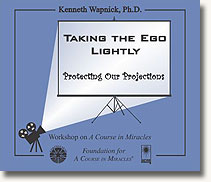
“Taking the Ego Lightly:

Protecting Our Projections” 

(click here)

This 2013 seminar discusses the dismantling of the ego’s serious thought system of sin, guilt, and fear. This is held in place by our projecting a serious world—personally and collectively—its purpose being to rivet our attention on the body. In this way we are distracted from the decision-making mind that is the source of the problem and the answer. But the ego is easily undone when we pay attention to the gentle little man (symbol for Jesus) just in back of us, always reminding us to laugh at his joke: “It is a joke to think that time can come to circumvent eternity… .” His loving presence encourages us to meet the ego’s seriousness—in all its forms—with a gentle giggle, tender tickle, and sweet smile.

(This is the last seminar Ken did before making his transition in Dec. 2013… and in that sense it is his last message to us in form.)


Filed Under: Home Posts Tagged With: A Course in Miracles, ACIM, ACIM Beginner Classes, forgiveness, Ken Wapnick, Peace, perception, Projection, School for A Course in Miracles, SFACIM

Our Current SFACIM Email Address…

May 3, 2021


For any school (SFACIM) related email:

we now only use lyncorona@msn.com

Thanks!


Regular Online Weekly Class Times :

(all times listed are Colorado Mountain Time Zone)

click here


New Online Class Participants:

 To register to receive the Zoom Class Link for Our Weekly Live Online SFACIM Classes:

click here


Filed Under: Announcements, Home Posts

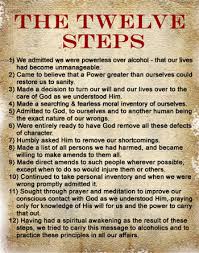
Musings… A Course in Miracles & 12 Step Recovery

April 29, 2021


A Course in Miracles (ACIM)

& 12 Step Recovery:

How are they the same, how are they different?

(by Tim W.)

Having spent many years in 12 step recovery programs & also having studied and practiced and shared  A Course in Miracles (ACIM) for more than 35 years, I would like to offer some of my thoughts about these two most powerful spiritual influences of the 20th and 21st Centuries… and how they both can lead us to a profound relationship with the God of our understanding.

But, I believe, in different ways.


My experience with the 12 Steps has taught me that there are three basic fundamentals to its process:

1 ) Step One…The Problem: That left to my self and my own isolated power, I am powerless over behaviors and attitudes in myself and others that are extremely self destructive.

2) Step Two… The Solution: That there is a potential relationship with a power greater than me (God) that can help restore me to peace and sanity, which helps me let go of my investments in those self-sabotaging behaviors in myself (and also let go of trying to fix them in others).

3) Steps 3-12… The How-to’s: That there are steps that I can take to work on my relationship with that higher power to help me to do just that, i.e. be restored to sanity and peace.


A Course in Miracles - combined volume - hardbound - English


My work with A Course in Miracles has shown me the non-dual nature of our one true being (unconditional Love)…

by working the three steps of forgiveness outlined in the Course:

1) The Problem: I believe I’m always upset for the reasons I think (that there are things and people, external to me, robbing me of my peace of mind)… but what if that’s simply not true.  What if, “I’m never upset for the reason I think.” (ACIM Workbook Lesson #5) What if it’s coming from me (internally in my mind) and not something ‘out there.’

2) The Solution: I could and can, with Jesus’ or the Holy Spirit’s help (a higher power), not only let go of blaming others. but let go of blaming  myself … and see us with peace instead of condemnation and judgment…  “I could see peace instead of this.” (ACIM WB Lesson #34)

3) The Result: And then, I will experience in my awareness in my mind that the true identity of others and myself as one innocent Son of God… is still intact, in spite of what we did or didn’t do behaviorally.  “I am not a body, I am free. I am (we are) still as God created me (us).” (ACIM WB Les.# 201-220)


So where do these two incredible approaches to our spiritual enlightenment overlap, and how might they be different?

I think in terms of sameness, the the first two steps in each process are basically identical.

The first step in the 12 Steps says simply I’m crazy insane, doing really self-destructive things, and I can’t stop.

The first step in the Course says ‘there must be another way,’ because the way I’m seeing and thinking  is just not working or helping (similar to Einstein’s definition of insanity: we keep doing the same thing over and over expecting a different result). I actually believe I am upset for the reason I think. What if that’s just not true? (ACIM Lesson # 5)

The second step in 12 Steps expresses the hope that, there is a power greater than me that can restore me to sanity. 

And in the Course, step two is that with help, “I could choose peace in my own mind instead of this insanity.” (ACIM Les. 34)… i.e. the insane way I see you, and the insane way I see myself.


However after those first two steps in each process, I believe that the two paths become markedly different in terms of approach. The reason is the way each process teaches and show us how to have a relationship with God. I think the Twelve Steps are about changing our behaviors, and doing very specific things, especially in steps 4 thru 9.

A Course in Miracles is about changing our perception, the way we see ourselves and each other. In my experience both work. Both can and will develop and enhance my relationship with God, myself, and others.

So, in framing the differences, the remaining steps 3-12 of the Twelve Steps are… things we do to accomplish our release from our obsessive behaviors and thinking, in the world.

The Course process is aimed at changing… how we see and judge things (what is our perception of others and ourselves and God in my mind).

The Twelve Steps have us do very helpful behavioral how-to’s, to release our motivation to hurt ourselves and others…. get a sponsor, write an inventory, make amends, learn how to meditate, etc….. basically changes in our personalities and bodies moving thru a world of time and space.

The goal of the Course (forgiveness) is always achieved by asking Jesus or the Holy Spirit to help us perceive others and ourselves the way he does, without judgment and condemnation, all taking place internally in a “place” ACIM calls the mind (not to be confused with our brains). He’s not asking us to give up  or sacrifice any particular behaviors…  though those destructive things we do to ourselves and others begin to “fall away” as we practice the Course and develop a new way of seeing each other and our self.


Granted… there are 365 lessons in the ACIM Workbook that could be viewed as 365 specific “steps” we take. However their emphasis is always about changing the way we see or experience ourselves and others, and always with Jesus or the Holy Spirit’s help (in the 12 Steps it’s similar to having a sponsor and a higher power.)

The Twelve Steps on the other hand, especially steps 3 thru 12, are very definite concrete things we do… to let go of our addictive behaviors and grow in our relationship with our higher power.

 I think ultimately the Twelve Steps and ACIM will take us to the same place, the same experience of oneness with God Our Father and  with all our brothers. Both spiritual systems are great. Both work. The deciding factor is to do one, or the other, or even both (but probably not both at the same time by mixing them together).


In 12 Step meetings I try to talk about the steps and how they work and have helped me let go of my self-destructive behaviors (including co-dependency)…. at the level of the world.

When I go to Course meetings, I try to talk about  the change in my own perception of who you and I are, through the Course process of forgiveness of laying down my judgements about us…. at the level of my own mind.

————————-

I think it is helpful and advisable to keep in mind how ACIM and the Twelve Steps are the same, and also how they are different… because each system is effective and complete in-and-of itself, without mixing it, or watering it down with another process. There are many paths up the mountain, but we can’t and shouldn’t take more than one path at a time. That would be silly and would simply work against the desired outcome. (One foot on one path and one foot in another… we will eventually trip and fall down, or just roll backward .)

Another way of saying this is that the 12 Steps are about letting go of addictions of the body and personality, whereas ACIM is about letting go of being addicted to believing we are a body in the first place, and recognizing and seeing (experiencing) who we truly are as God’s Son.

——————–

In choosing which of these two approaches (or any really) to spiritual growth, the question ultimately becomes… what do I feel drawn to do in my heart? What do I honestly think is the best approach for me now?

Certainly take whatever approach you think is best for you. As Ken Wapnick, my favorite Course mentor and teacher used to say…  it would be silly not to.

And, as always… ask Jesus, or the Holy Spirit, or our higher power…  for help to see each other peacefully, while doing whatever it is we are doing.


Class Video Replay

from School for a Course in Miracles…

on moving from believing in an identity of weakness and hopelessness…

to experiencing our True Identity of strength and hope:

click here


Filed Under: Home Posts

  • « Previous Page
  • 1
  • 2
  • 3
  • 4
  • 5
  • 6
  • …
  • 10
  • Next Page »

Search A Course in Miracles topic or class on this website: Type your search here & then hit “Enter”

Help School for ACIM Provide Our Weekly Online Classes on The Study & Practice of ACIM


ONLINE Weekly SFACIM Classes:

SFACIM: Summer Break thru Aug. 7… Complete Schedule of Classes & Discussion Sessions Online on Zoom (8/8-10/31)

ZOOM Link for Weekly SFACIM 90 Minute Classes… and 75 Min. Discussion Sessions

After first two weeks of donation-free classes: Suggested monthly donations to continue access to weekly live online classes… and also receive link for SFACIM Video Library with hundreds of Class Replays

Sundays: 9:30am Mt. on The ACIM Text (90 min.)

Sunday ACIM Vesper Sessions with Lyn @ 6pm Mt

Mondays: Zoom Discussions on ACIM @ 9:30am Mt (begin in August). … & … Classes on Ken Wapnick’s “Journey Through The Text” @ 5:30pm Mt. Time

Tuesdays Online: “Together on The Resurrection Road” 10-11:30am Mt.

Wed. Gathering of Men: Online ACIM Men’s Discussion Group @ 5:30pm Mt.

Thursdays @ 9:30am Mt Morning Mattins (ACIM prayers and quiet time) & 5:30pm Mt: Discussions of FACIM Books on ACIM (“The Transformed World & The Thunder of The Meaningless”)

Fridays: 75 Min. Zoom ACIM Discussion Sessions on “The Song of Prayer Pamphlet” @ 9:30am Mt

Saturdays @ 9:30am Mt. on Current WB Lessons of The Week

Some Recent SFACIM Class Replays…

New Classes & Upcoming Events:

 Guidelines for SFACIM Online Class Participation: We are a School for A Course in Miracles (SFACIM), whose classes’ purpose is to present a coherent, consistent, and clear process of forgiveness based on Dr. Kenneth Wapnick’s teachings on Jesus’s A Course in Miracles (ACIM). **Unlike most ACIM meetings and discussion groups, our SFACIM classes are different in […]

  The Two Pamphlets & The Prose Poem:   There were three other works from Jesus that Helen Schucman “scribed” after she finished taking down A Course in Miracles itself which was completed in 1972. They were called Psychotherapy Pamphlet, the Song of Prayer Pamphlet, and the Gifts of God Prose Poem.   (1) Psychotherapy: […]

  Sunday ACIM Sessions with Lyn @ 6pm Mt   45-60 min. sessions,  free and unrecorded. we will rest together in the stillness… with some discussion, selected  readings and some quiet time. For complete SFACIM weekly Schedule, and for Zoom link if you do not already have it,  click here

                                            Beginning on May 7th: Thursdays @   9am Mt.    ACIM Matins {Morning Vespers}  45 min.    Please join our current Thurs. series… you can come try it at any time and see if […]

Announcements:

SFACIM: Summer Break thru Aug. 7… Complete Schedule of Classes & Discussion Sessions Online on Zoom (8/8-10/31)

Beginners: New or Fairly New to A Course in Miracles?

ACIM 10 min. video clips by Ken Wapnick

Sunday ACIM Vesper Sessions with Lyn @ 6pm Mt

Thursdays @ 9:30am Mt Morning Mattins (ACIM prayers and quiet time) & 5:30pm Mt: Discussions of FACIM Books on ACIM (“The Transformed World & The Thunder of The Meaningless”)

Our Current SFACIM Email Address…

All Course quotes are from A Course in Miracles, copyright ©1992, 1999, 2007 by the Foundation for Inner Peace, 448 Ignacio Blvd., #306, Novato, CA 94949, ACIM.org (Contact), used with permission.

Site Map · Copyright © 2025 · Lyn Corona
customized by Intent Design Studio (editor of ACIMblog.com) · hosted by BlueHost · WordPress